How to Half Double Crochet for Beginners: Easy Step-by-Step Guide
Half double crochet is one of those stitches that can feel confusing when you first read the name, but the actual movement is surprisingly simple.
If you already know single crochet, half double crochet adds just one yarn over before you insert the hook. If you have tried double crochet, the biggest difference is that you pull through all three loops at once instead of working the loops off in two stages.
In this beginner tutorial, you will learn how to half double crochet from a foundation chain, where to insert your hook, why you should have three loops on the hook, how to start the next row, and how to keep your edges from getting wider or narrower.
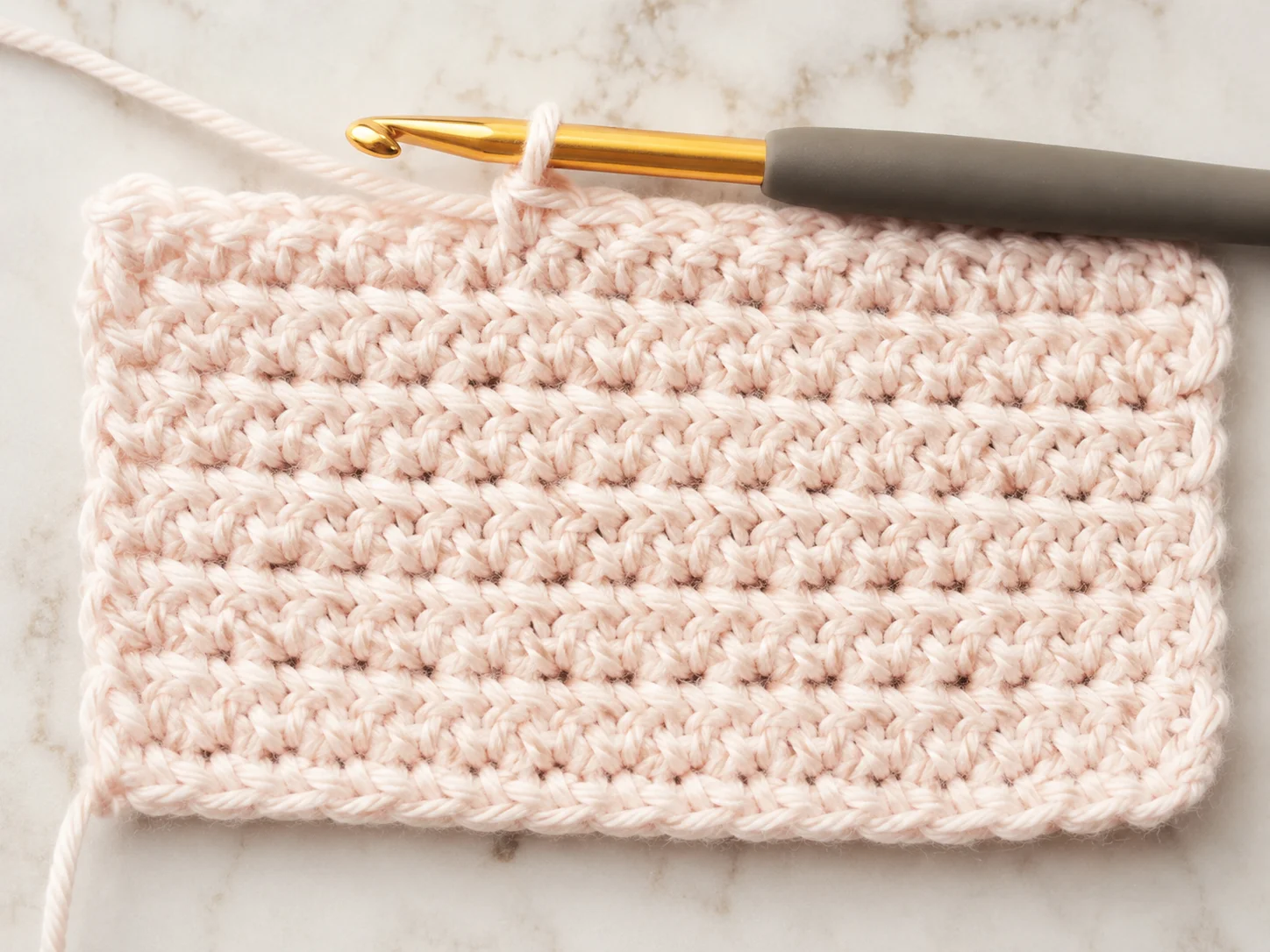
By the end, you will have a small 10-stitch, 5-row practice swatch and know exactly what a correct half double crochet stitch should look and feel like.
Quick Answer: To make a U.S. half double crochet, yarn over, insert your hook into the stitch, yarn over and pull up a loop. You should now have 3 loops on your hook. Yarn over once more and pull through all 3 loops at the same time. One loop remains on your hook, and your half double crochet is complete.
Half Double Crochet at a Glance
| What to Know | Half Double Crochet |
|---|---|
| U.S. abbreviation | hdc |
| U.K. equivalent | half treble crochet, or htr |
| Stitch height | Between single and double crochet |
| Loops on hook before final pull-through | 3 |
| Final movement | Yarn over and pull through all 3 loops |
| Turning chain used in this tutorial | Chain 2 |
| Does our turning chain count as a stitch? | No |
| Beginner practice yarn | Smooth #4 medium-weight yarn |
| Practice hook | 5.0 mm |
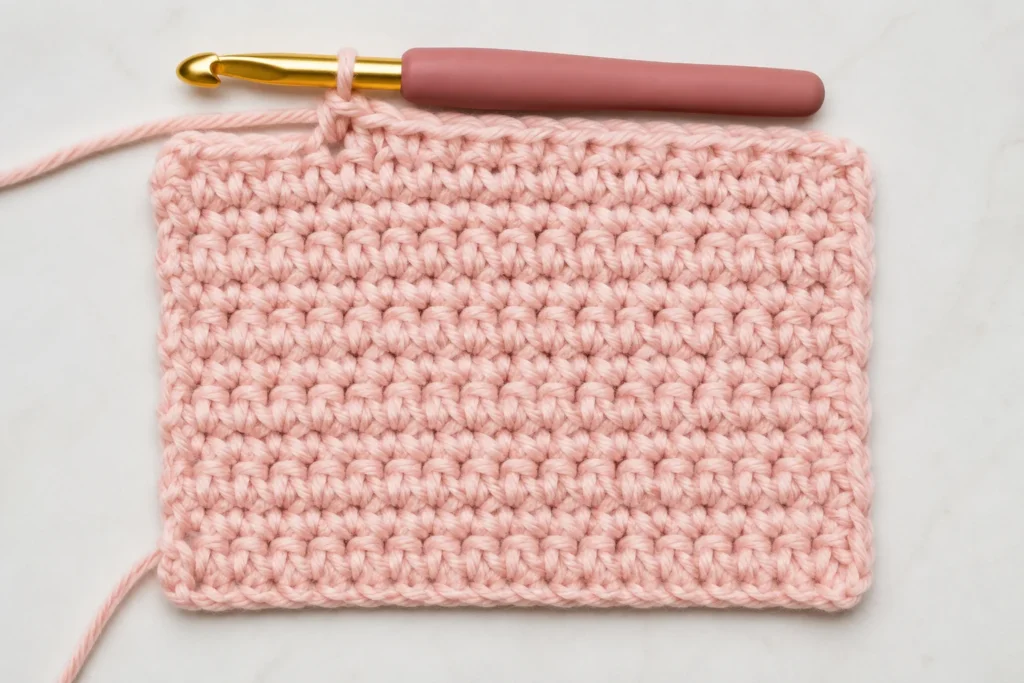
What Is a Half Double Crochet Stitch?
Half double crochet, abbreviated hdc in U.S. crochet patterns, is a basic stitch that sits between single crochet and double crochet in height.
It begins with a yarn over, just like double crochet.
The difference comes after you pull up a loop.
Instead of pulling through two loops and then through two loops again, you yarn over and pull through all three loops at once.
The basic movement is:
- Yarn over.
- Insert the hook into the stitch.
- Yarn over and pull up a loop.
- You now have 3 loops on the hook.
- Yarn over.
- Pull through all 3 loops.
You finish with one loop remaining on your hook.
That one-loop finish is your signal that the stitch is complete.
Half double crochet creates rows that build more quickly than single crochet but still have a fairly solid fabric compared with taller stitches.
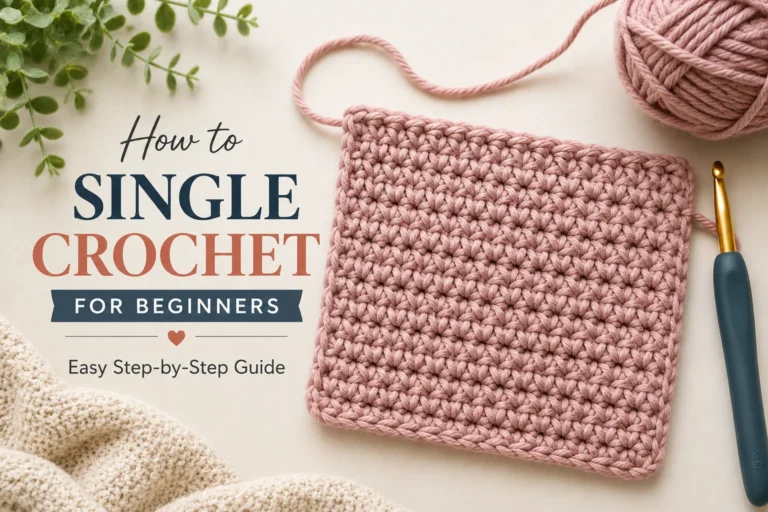
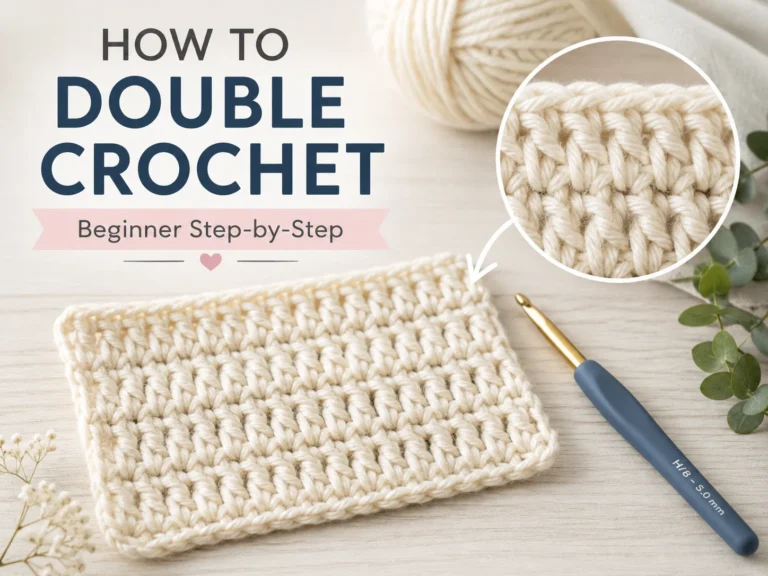
If you have not practiced the shorter stitch yet, our how to single crochet for beginners tutorial is a useful place to start. If you want to compare HDC with a taller stitch afterward, see our how to double crochet for beginners guide.
Important: U.S. vs. U.K. Half Double Crochet
This tutorial uses U.S. crochet terminology, which is the terminology used throughout Lia Crafts unless stated otherwise.
The Craft Yarn Council crochet abbreviations list hdc as half double crochet in U.S. terminology and show its U.K. equivalent as half treble crochet.
The same physical stitch has a different name in U.K. terminology:
| U.S. Term | U.K. Equivalent |
|---|---|
| Single crochet, sc | Double crochet, dc |
| Half double crochet, hdc | Half treble crochet, htr |
| Double crochet, dc | Treble crochet, tr |
So if a U.K. pattern asks for a half treble crochet, it is referring to the stitch taught in this tutorial.
Always check whether a pattern uses U.S. or U.K. terminology before beginning. Our how to read crochet patterns guide explains this difference along with common crochet abbreviations and pattern instructions.
What You Need to Practice Half Double Crochet
You do not need a large crochet kit for this practice swatch.
Use:
- Smooth #4 medium or worsted-weight yarn
- A 5.0 mm crochet hook
- Scissors
- A yarn needle for finishing the ends
- Optional removable stitch markers
For a first practice swatch, choose a light or medium solid yarn color.
Cream, light pink, mint, pale blue, or another easy-to-see shade will make the top V of each stitch easier to identify.
Try to avoid black yarn, very dark colors, fuzzy yarn, or heavily textured yarn while you are learning. They can make it much harder to see exactly where your hook should go.
If yarn labels, yarn weights, hook letters, and millimeter sizes are still confusing, read our crochet hook sizes and yarn weights guide first.
Before You Start: Know What Counts as a Chain
For our practice swatch, you will begin with:
Chain 12.
The working loop currently sitting on your crochet hook does not count as one of those chains.
After making 12 chains, you should be able to count 12 separate chain links below the hook.
For the first half double crochet, we will work into the:
third chain from the hook.
Count away from the hook:
1 → 2 → 3
Do not count the loop currently on the hook.
Working into the wrong starting chain is one of the easiest ways to end up with the wrong stitch count before your first row has even begun.
If making a slip knot or foundation chain still feels unfamiliar, start with our crochet guide for absolute beginners and come back when you are comfortable making a short chain.
How to Half Double Crochet Step by Step
We will make a small swatch with 10 half double crochet stitches in each row.
Take your time with the first few stitches. Accuracy matters more than speed while you are learning the movement.
Step 1: Make a Slip Knot and Chain 12
Make a slip knot and place it on your hook.
Chain 12.
Try to keep your chains relaxed and reasonably even.
They do not need to look perfect.
The important thing is that you can insert your hook into them without forcing it.
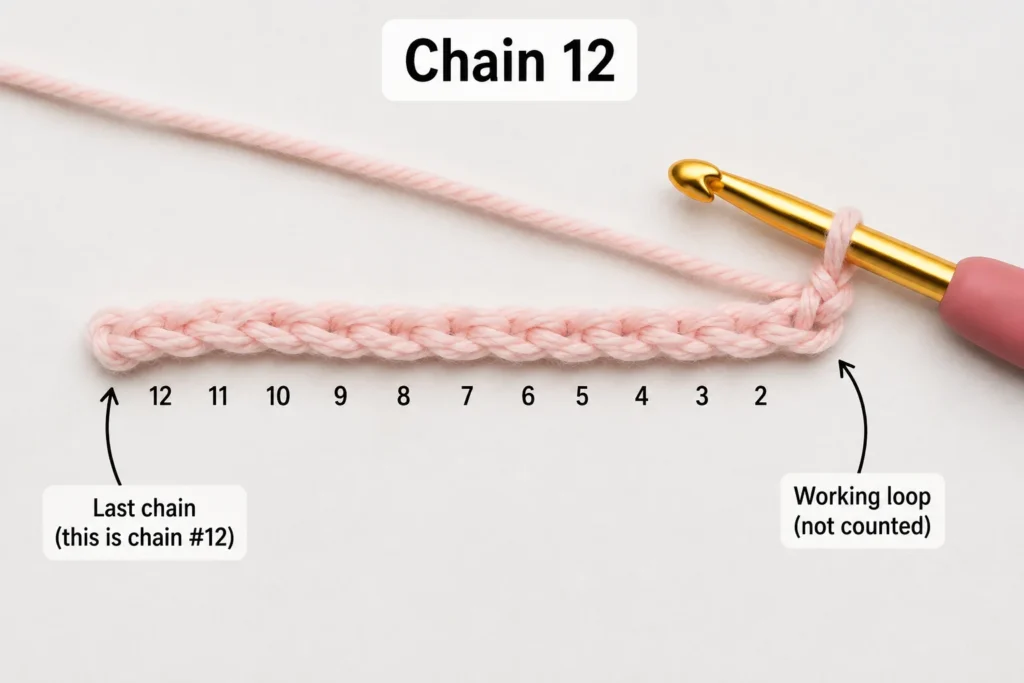
What you should see:
Twelve visible chain stitches below your hook and one working loop sitting on the hook.
Beginner mistake to avoid:
Do not count the working loop as chain number 13.
Step 2: Yarn Over
Bring the working yarn over your crochet hook from back to front.
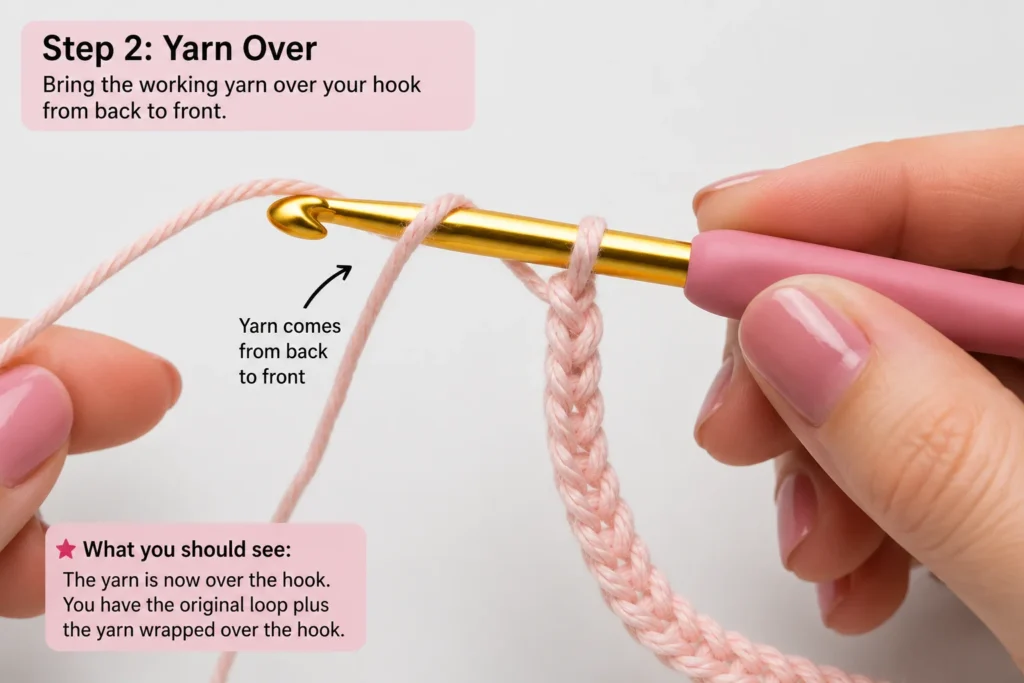
This is called a yarn over, often abbreviated as yo in crochet instructions.
You now have the original loop plus the yarn wrapped over the hook.
This yarn over is what separates the beginning of a half double crochet from a single crochet.
Beginner mistake to avoid:
Do not insert the hook first. Half double crochet begins with the yarn over.
Step 3: Insert the Hook Into the Third Chain From the Hook
Starting next to the hook, count:
1, 2, 3
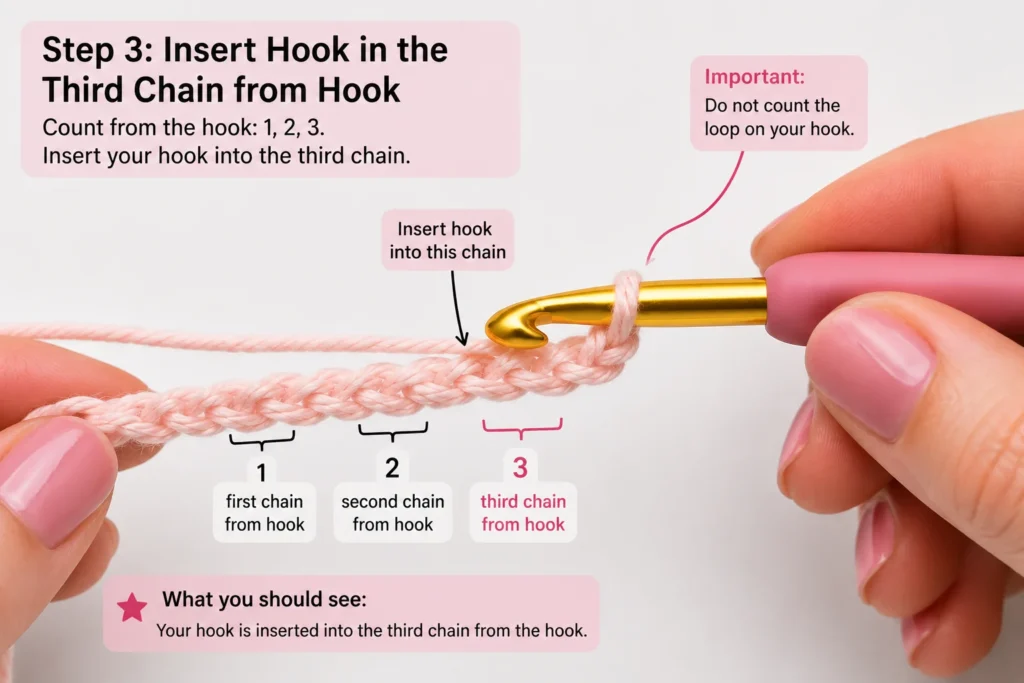
Insert your hook into the third chain.
Remember that the working loop on your hook is not included in the count.
The first two skipped chains give you enough height to begin the row.
They are not counted as one of our 10 half double crochet stitches in this tutorial.
What you should see:
Your hook passes through the third chain while the yarn over remains on the hook.
Step 4: Yarn Over and Pull Up a Loop
Yarn over again.
Pull that yarn back through the chain.
Now stop and look at your hook.
You should have:
3 loops on the hook.
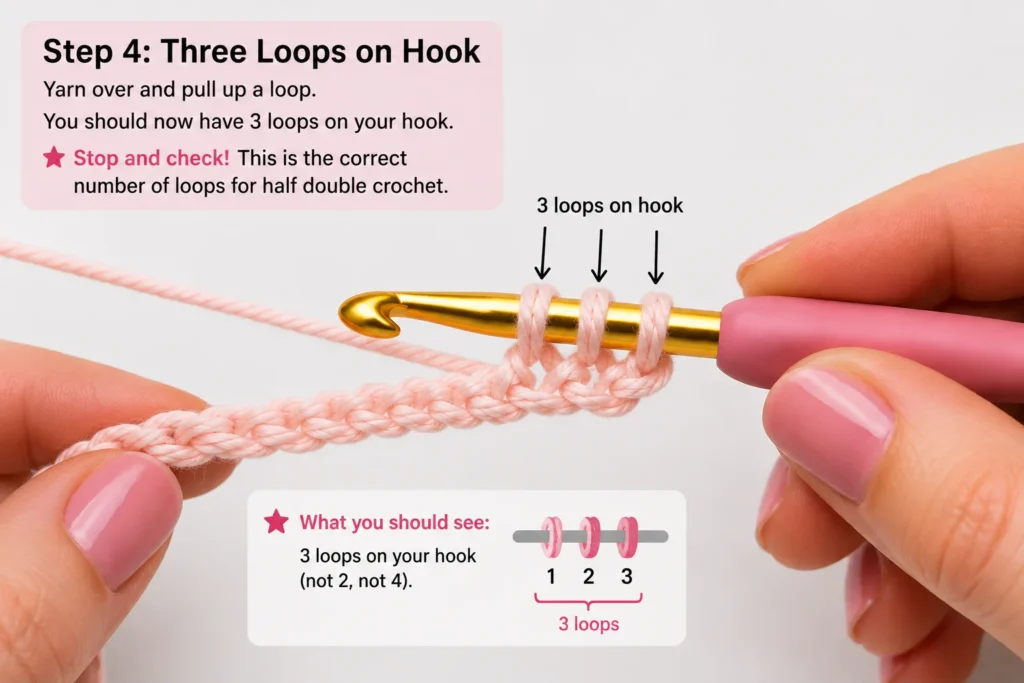
This is an important visual checkpoint.
If you only have two loops, you probably forgot the first yarn over.
If you have three, you are ready for the final movement.
Step 5: Yarn Over and Pull Through All 3 Loops
Yarn over one more time.
Now gently draw the yarn through all three loops on the hook in one movement.
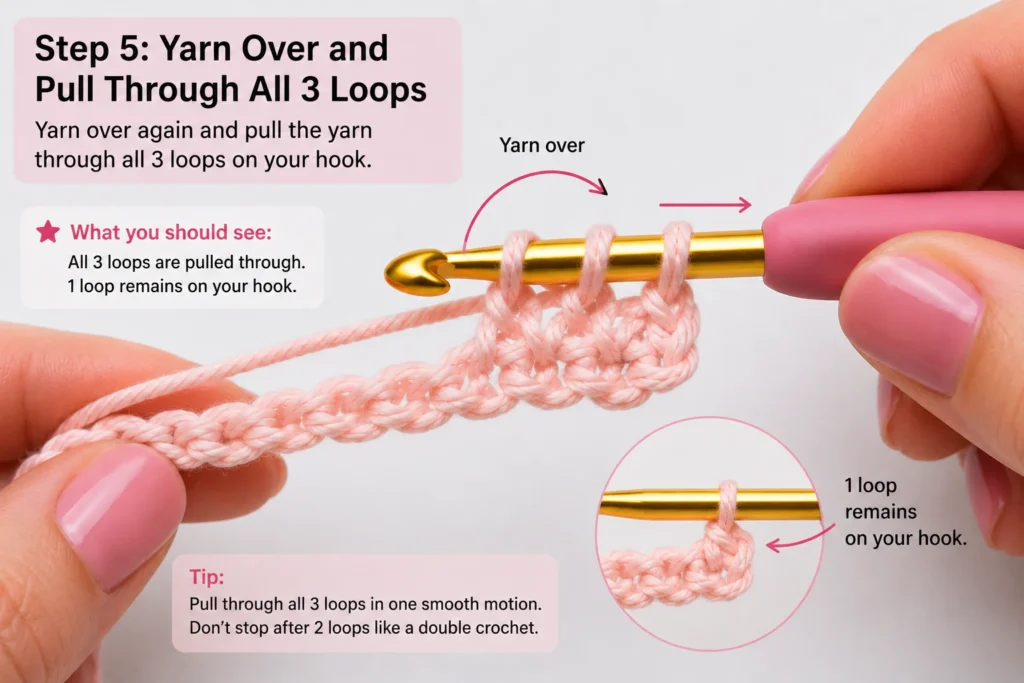
You should finish with:
1 loop on your hook.
Your first half double crochet is complete.
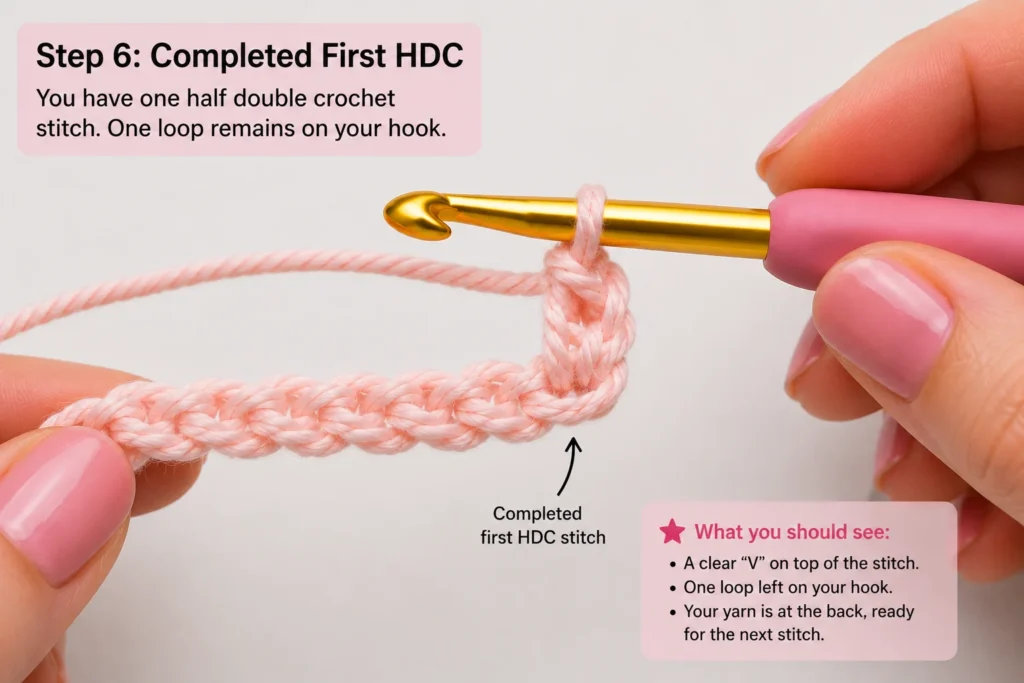
The full sequence is:
Yarn over → insert → yarn over → pull up a loop → 3 loops → yarn over → pull through all 3.
If the movement feels awkward, repeat that sequence slowly rather than trying to crochet faster.
Step 6: Make a Half Double Crochet in the Next Chain
Yarn over.
Insert your hook into the next chain.
Yarn over and pull up a loop.
Check that you have three loops.
Yarn over again and pull through all three loops.
You have now made your second half double crochet.
Continue making one half double crochet in each remaining chain.
Step 7: Finish Row 1 and Count Your Stitches
Continue across the foundation chain until there are no chains left to work into.
You should have:
10 half double crochet stitches.
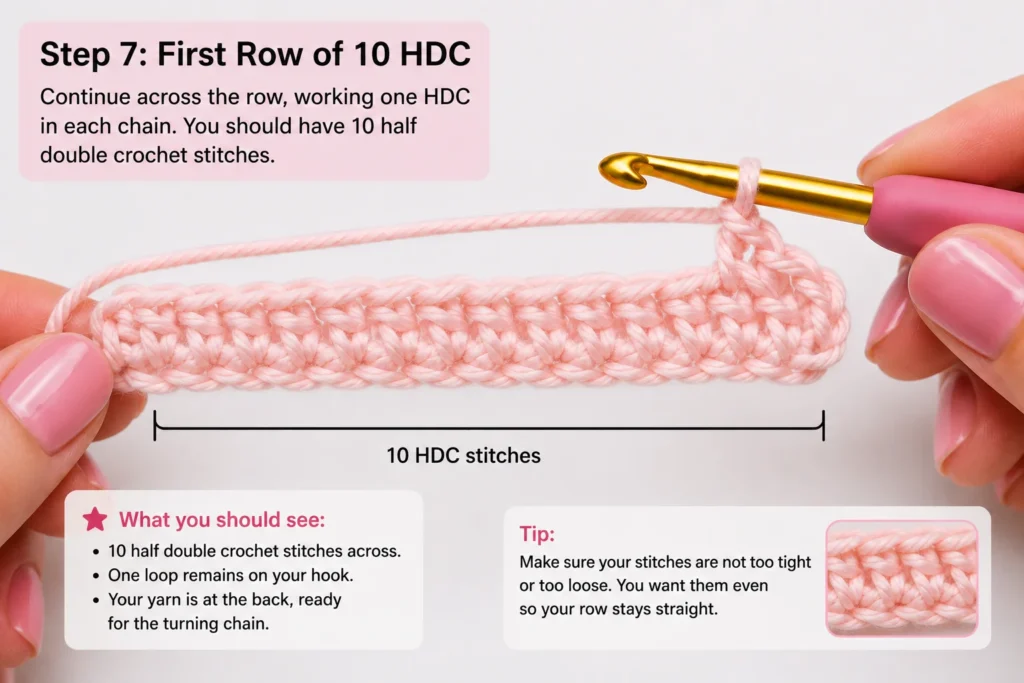
Do not count the working loop on your hook.
Do not count the two skipped chains at the beginning as an extra stitch.
Before moving to Row 2, count the stitches across the top of your work.
You should see 10 V-shaped stitch tops.
If you have 9 or 11, it is easier to find the mistake now than after several more rows.
How to Start the Next Row of Half Double Crochet
Making the stitch itself is only half of the skill.
Beginners often understand the HDC movement but begin losing or adding stitches when they turn their work.
For this tutorial, we will use a simple rule:
Chain 2 does not count as a stitch.
That means you will work into the first actual half double crochet after turning.
Step 1: Chain 2
With one loop on your hook, make two chain stitches.
These chains give your hook enough height for the next row.
In this tutorial, the chain-2 is a turning chain only.
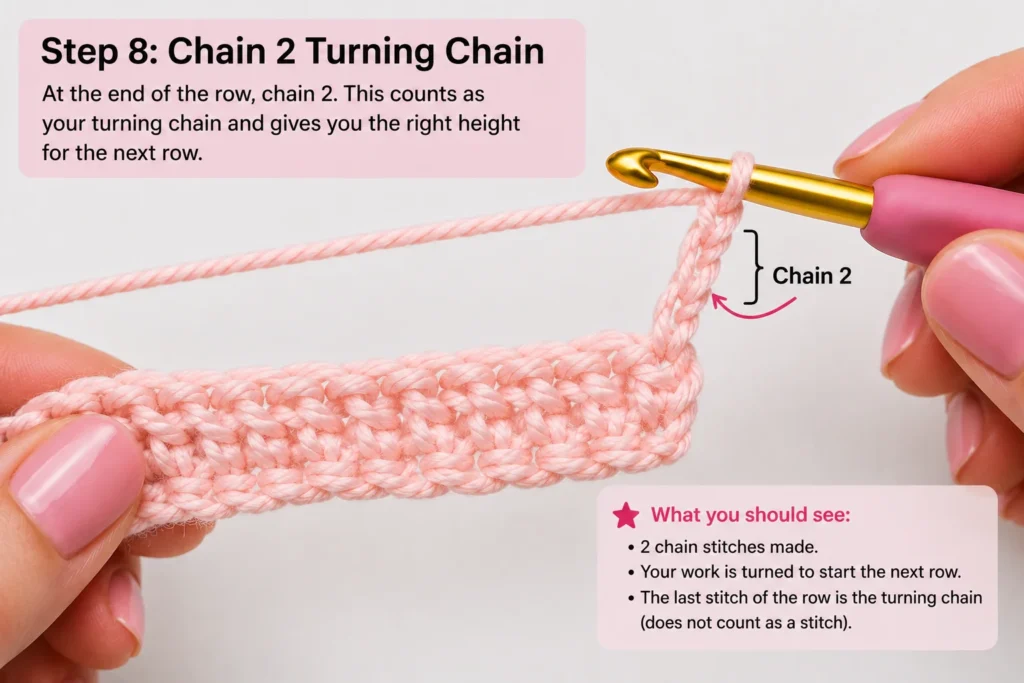
It does not count as one of your 10 stitches.
Step 2: Turn Your Work
Turn your crochet piece so you can work back across the row you just completed.
Keep the working loop on your hook while you turn.
Your chain-2 will now sit at the edge of the work.
Step 3: Work Into the First Stitch
Look directly below the turning chain for the first real half double crochet from the previous row.
At the top of that stitch you should see a small V.
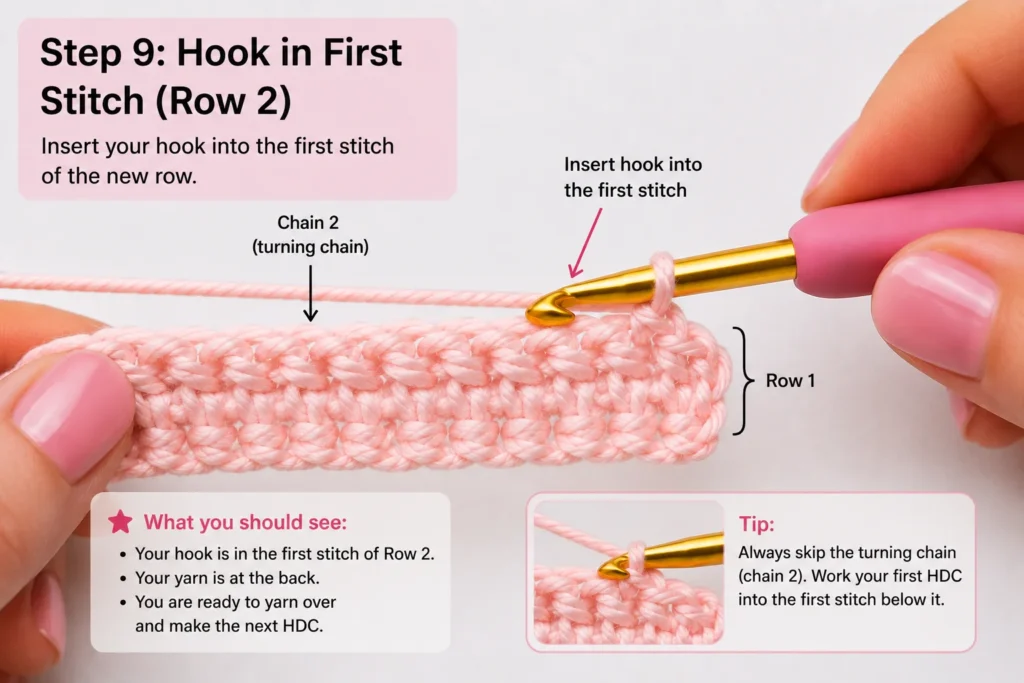
Yarn over and insert your hook under the two top loops of that V.
Complete a half double crochet:
Yarn over, pull up a loop, yarn over, pull through all three loops.
Because the turning chain does not count as a stitch, you do not skip this first stitch.
Step 4: Half Double Crochet Across
Work one half double crochet into each stitch across the row.
For each stitch:
- Yarn over.
- Insert under the top two loops of the next stitch.
- Yarn over and pull up a loop.
- Check for 3 loops.
- Yarn over and pull through all 3 loops.
Continue until you reach the final stitch.
Step 5: Work Into the Last Real Stitch
The last stitch is easy to miss because it sits close to the edge and turning chain.
Look for the final V-shaped stitch top from the previous row.
Work one half double crochet into it.
Do not work an extra stitch into the chain-2 turning chain.
Count again.
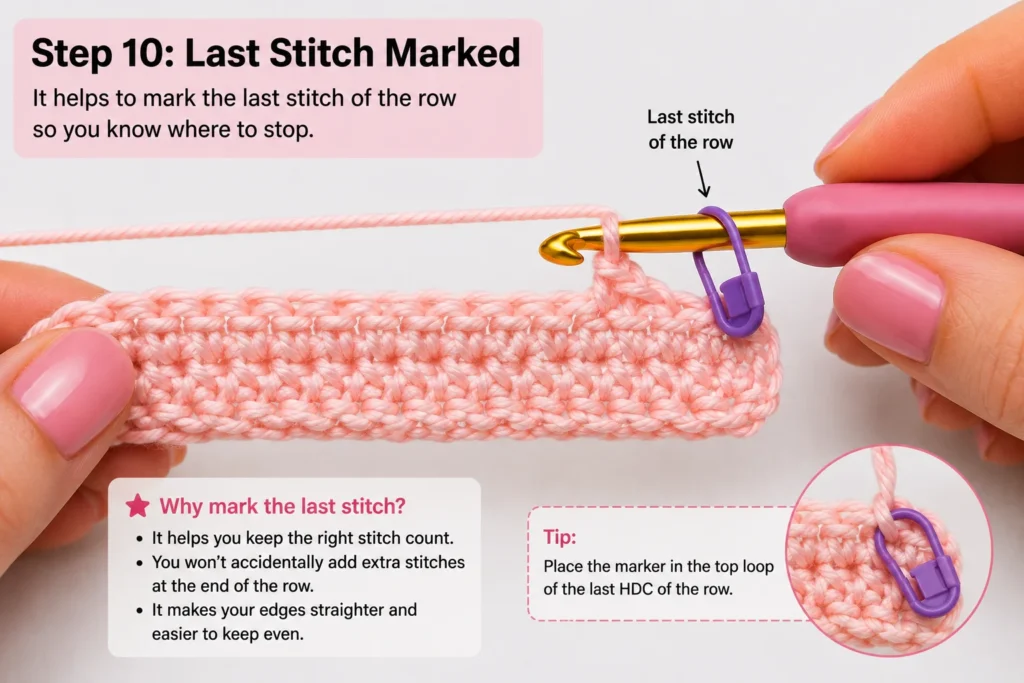
You should still have:
10 half double crochet stitches.
If you have 10 stitches after Row 1 and 10 after Row 2, your edges are already much more likely to stay straight.
Lia’s Practical Note
When I work a beginner practice swatch, the part I watch most closely is not the middle of the row. It is the first and last stitch.
The HDC movement becomes repetitive fairly quickly, but edge stitches are easy to overlook because they sit close to the turning chain. I like to count every row while the swatch is small. If the edges are difficult to recognize, placing a removable stitch marker in the first and last stitch makes the next row much easier to check.
A Simple 5-Row Half Double Crochet Practice Swatch
Use this small swatch to practice the stitch before starting a full project.
Foundation
Chain 12.
Row 1
Half double crochet in the third chain from the hook.
Half double crochet in each remaining chain across.
10 hdc.
Row 2
Chain 2 and turn.
The chain-2 does not count as a stitch.
Half double crochet in the first stitch and in each stitch across.
10 hdc.
Rows 3 to 5
Repeat Row 2.
After every row, stop and count.
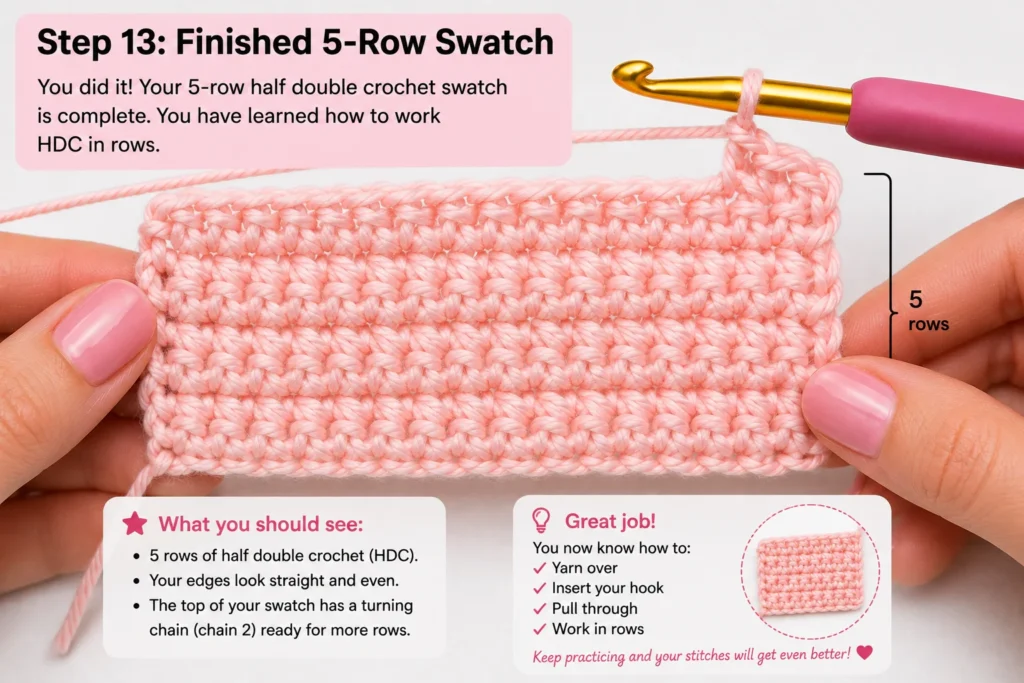
You should have:
10 stitches in every row.
Do not worry if your first swatch is not perfectly rectangular.
The goal is to practice:
- the yarn over
- finding the next stitch
- pulling through all three loops
- recognizing the first and last stitch
- maintaining the same stitch count
Once those movements start feeling natural, even tension becomes much easier to work on.
How to Count Half Double Crochet Stitches
Look across the top edge of your row.
Each completed half double crochet creates a V-shaped top.
For this swatch:
1 V = 1 half double crochet stitch
Count each V from one side to the other.
There should be 10.
Do not count:
- the working loop on your hook
- the chain-2 turning chain used in this tutorial
Another useful clue is the vertical body of each stitch, but counting the top V shapes is usually easier for beginners.
Why Does Half Double Crochet Have a Horizontal Bar?
Half double crochet has a distinctive structure created by the yarn over that remains part of the stitch when all three loops are pulled through together.
Depending on which side of the fabric you are looking at, you may notice an extra horizontal strand running across the stitch.
This is normal.
Later, you can deliberately work into different loops or this extra strand to create textured variations, but for a standard half double crochet, simply insert your hook under the top two loops of the next stitch unless your pattern tells you otherwise.
The Half Double Crochet Turning Chain Explained
Turning chains are one of the most confusing parts of learning crochet because different stitches and patterns can use them differently.
For the swatch in this tutorial:
Chain 2 → turn → work into the first stitch
The chain-2:
does not count as a stitch.
This gives us a simple edge rule:
| At the Beginning of the Row | At the End of the Row |
|---|---|
| Ch 2 and turn | Finish in the last real HDC |
| Do not count ch-2 as a stitch | Do not add an HDC into the turning chain |
| Work HDC into the first stitch | Count 10 actual HDC stitches |
However, not every crochet pattern uses the same turning-chain convention.
Some patterns may use a chain 1. Others may tell you that a beginning chain counts as a stitch.
When following a pattern, always follow that pattern’s instructions rather than automatically applying the rule from a different project.
Common Half Double Crochet Mistakes and How to Fix Them
| Problem | Likely Cause | How to Fix It |
|---|---|---|
| Only 2 loops appear on the hook | You forgot the first yarn over | Yarn over before inserting the hook |
| You pull through 2 loops and then 2 again | You are completing the motion like a double crochet | Pull through all 3 loops at once for HDC |
| Row gets narrower | A first or last stitch is being skipped | Count every row and mark edge stitches |
| Row gets wider | You may be working into the turning chain or adding an extra edge stitch | Remember that our ch-2 does not count |
| Hook is difficult to insert | Foundation chain or stitches are too tight | Relax your yarn tension and avoid pulling each loop tight |
| Stitches look uneven | Loop height or tension changes from stitch to stitch | Slow down and keep the hook movements similar |
| Yarn splits | Hook is catching only part of the yarn strand | Insert the hook cleanly and use smooth yarn while practicing |
| You cannot see the next stitch | Yarn is dark, fuzzy, or highly textured | Practice with smooth, light-colored yarn |
Mistake 1: Forgetting the First Yarn Over
This is probably the easiest movement to forget when switching from single crochet.
Half double crochet always starts:
yarn over first.
If you insert your hook without that first yarn over, you will not have the three loops needed for a standard HDC.
Use the rhythm:
YO → insert → YO → pull up → YO → through 3
until the movement becomes automatic.
Mistake 2: Pulling Through Only Two Loops
If you have practiced double crochet recently, your hands may automatically try to pull through two loops at a time.
For half double crochet, do not stop after two.
Once you have three loops on your hook:
yarn over and pull through all three.
Mistake 3: Missing the Last Stitch
If your swatch starts with 10 stitches but becomes:
10 → 9 → 8 → 7
you are probably losing an edge stitch.
The final stitch can lean toward the side and become harder to see.
Place a removable stitch marker in the first and last stitch of each row until you can recognize them easily.
Mistake 4: Adding an Extra Stitch at the Edge
If your swatch becomes wider every row, check what you are doing near the turning chain.
For this tutorial, your chain-2 does not count as a stitch.
Do not work another HDC into that turning chain at the end of the next row.
Count the actual V-shaped stitch tops instead.
How to Keep Your Half Double Crochet Edges Straight
Straight edges depend more on consistent stitch placement than on perfect tension.
For a beginner practice swatch:
- Start every row with the same turning-chain method.
- Work into the first real stitch.
- Make one HDC in each stitch across.
- Find the final real stitch.
- Ignore the turning chain.
- Count 10 stitches before starting the next row.
If you are unsure about an edge, use stitch markers.
Put one marker into the first HDC and another into the last HDC.
When you return to those stitches on the next row, you will know exactly where the row begins and ends.
Half Double Crochet vs. Single Crochet vs. Double Crochet
Half double crochet makes more sense when you compare the three movements.
| Stitch | Starting Movement | Loops Before Final Steps | How Loops Are Worked Off | Relative Height |
|---|---|---|---|---|
| Single crochet, sc | Insert hook | 2 | Pull through 2 | Short |
| Half double crochet, hdc | Yarn over, insert hook | 3 | Pull through all 3 | Medium |
| Double crochet, dc | Yarn over, insert hook | 3 | Pull through 2, then through 2 | Tall |
The easiest memory trick is:
Single crochet: 2 loops, pull through 2.
Half double crochet: 3 loops, pull through 3.
Double crochet: 3 loops, pull through 2, then 2.
HDC sits naturally between the other two stitches in both its motion and finished height.
What Does Half Double Crochet Fabric Look Like?
A standard half double crochet fabric usually looks compact but not as short as single crochet.
The stitches have visible V-shaped tops and a subtle extra horizontal strand in the stitch structure.
Compared with single crochet, each row gains more height.
Compared with double crochet, the rows are shorter and the fabric generally looks less open.
The exact appearance can still change depending on:
- yarn fiber
- yarn thickness
- hook size
- tension
- whether you work through both loops or use a loop variation
That is why the same stitch can look slightly different in two projects.
Can You Half Double Crochet in the Round?
Yes.
The actual half double crochet movement remains the same:
Yarn over → insert → yarn over → pull up a loop → yarn over → pull through all 3 loops.
What changes is how the rounds are constructed.
A pattern may use:
- joined rounds
- continuous rounds
- a beginning chain
- a stitch marker
- different instructions about whether a beginning chain counts as a stitch
Always read the pattern notes before starting a round.
The basic HDC stitch itself does not change.
What Can You Make With Half Double Crochet?
Half double crochet is useful in many types of projects because it gives you more height than single crochet without becoming as tall as double crochet.
You may see it used in:
- scarves
- blankets
- hats
- headbands
- cowls
- garments
- bags
- simple squares
- baby projects
- textured stitch patterns
For your first HDC project, choose something with straight rows and a simple stitch count.
A small scarf, headband, or practice square lets you focus on the stitch rather than complicated shaping.
Beginner Half Double Crochet Variations to Learn Later
Once the standard HDC feels comfortable, you may come across variations such as:
Half Double Crochet in the Back Loop Only
Instead of inserting under both top loops, you work only through the back loop.
This changes the texture of the fabric.
Half Double Crochet in the Front Loop Only
The hook goes through only the front loop of the stitch.
This creates a different raised or ridged effect.
Half Double Crochet in the Third Loop
Half double crochet has an extra horizontal strand that can be used as a working loop in certain patterns.
Working into it pushes the usual top V forward and can create a knit-like texture.
You do not need any of these variations to learn basic HDC.
First become comfortable working a normal half double crochet under both top loops.
How to Fasten Off Your Practice Swatch
After completing Row 5, leave the working loop on your hook.
Cut the yarn, leaving a tail long enough to handle easily.
Pull the cut yarn tail completely through the working loop.
Gently tighten it.
Use a yarn needle to weave the loose ends into the fabric rather than cutting them directly against the final stitch.
Your first half double crochet practice swatch is finished.
Half Double Crochet FAQs
What does HDC mean in crochet?
HDC stands for half double crochet in U.S. crochet terminology.
It is a basic crochet stitch made by yarning over, inserting the hook, pulling up a loop, then yarning over and pulling through all three loops on the hook.
Is half double crochet easy for beginners?
Yes. Once you understand the yarn over and the three-loop pull-through, the stitch uses a short repeating sequence.
For many beginners, keeping the correct stitch count at the edges takes more practice than making the HDC itself.
How many loops should I have for a half double crochet?
After you yarn over, insert your hook, yarn over again, and pull up a loop, you should have three loops on your hook.
Yarn over once more and pull through all three loops to complete the stitch.
What chain do I start half double crochet in?
For the practice method in this tutorial, make your first half double crochet in the third chain from the hook.
Do not count the working loop currently sitting on the hook.
Always follow the starting-chain instructions given in an individual pattern because pattern conventions can vary.
How many chains do you make when turning half double crochet?
This tutorial uses chain 2 before turning.
The chain-2 provides height but does not count as a stitch in our practice swatch.
Some patterns use another method, so check the pattern instructions before assuming the turning chain rule.
Does chain 2 count as a half double crochet?
Not in the method used in this tutorial.
Our chain-2 is a turning chain only.
After turning, work your first HDC into the first actual stitch and do not count the chain-2 in your stitch total.
Other patterns may specify a different convention.
Where do I insert my hook in the next row?
For a standard half double crochet, insert your hook under the two top loops of the next stitch, which look like a V from above.
If a pattern says BLO, FLO, third loop, or gives another placement instruction, follow that instruction instead.
Why is my half double crochet getting wider?
You may be adding an extra stitch at the beginning or end of a row.
With the method in this tutorial, make sure you are not counting or working into the chain-2 as an additional stitch.
Count your stitches after every row while practicing.
Why is my half double crochet getting narrower?
You are probably missing a stitch, often the first or last stitch of the row.
Use removable stitch markers in both edge stitches and count your row before beginning the next one.
What is the difference between half double crochet and double crochet?
Both stitches begin with a yarn over and produce three loops on the hook after you pull up a loop.
For HDC, yarn over and pull through all three loops at once.
For double crochet, yarn over and pull through two loops, then yarn over and pull through the remaining two loops.
This makes double crochet taller than half double crochet.
What is half double crochet called in the U.K.?
A U.S. half double crochet is called a half treble crochet, abbreviated htr, in U.K. crochet terminology.
Can I use half double crochet instead of single crochet?
Technically you can substitute stitches in some simple projects, but the finished fabric will not be identical.
Half double crochet is taller than single crochet, so changing the stitch may affect the project’s height, gauge, texture, yarn usage, and final dimensions.
For a pattern where size matters, use the stitch specified by the designer unless you are prepared to recalculate the pattern.
Final Beginner Check
Before moving on from this tutorial, make sure you can do these six things:
- Start an HDC with a yarn over.
- Identify the third chain from the hook.
- Recognize three loops on the hook.
- Pull through all three loops in one movement.
- Find the first and last stitch of a row.
- Keep the same stitch count for several rows.
If you can make five rows with 10 stitches in every row, you have learned the basic half double crochet stitch.
Do not worry about making every stitch perfectly identical yet.
Consistent tension comes with repetition.
For now, focus on knowing where your hook goes, how many loops you should see, and how many stitches belong in each row. Once those three things are clear, half double crochet becomes a simple rhythm you can use in all kinds of crochet projects.