Crochet Hook Sizes and Yarn Weights Explained
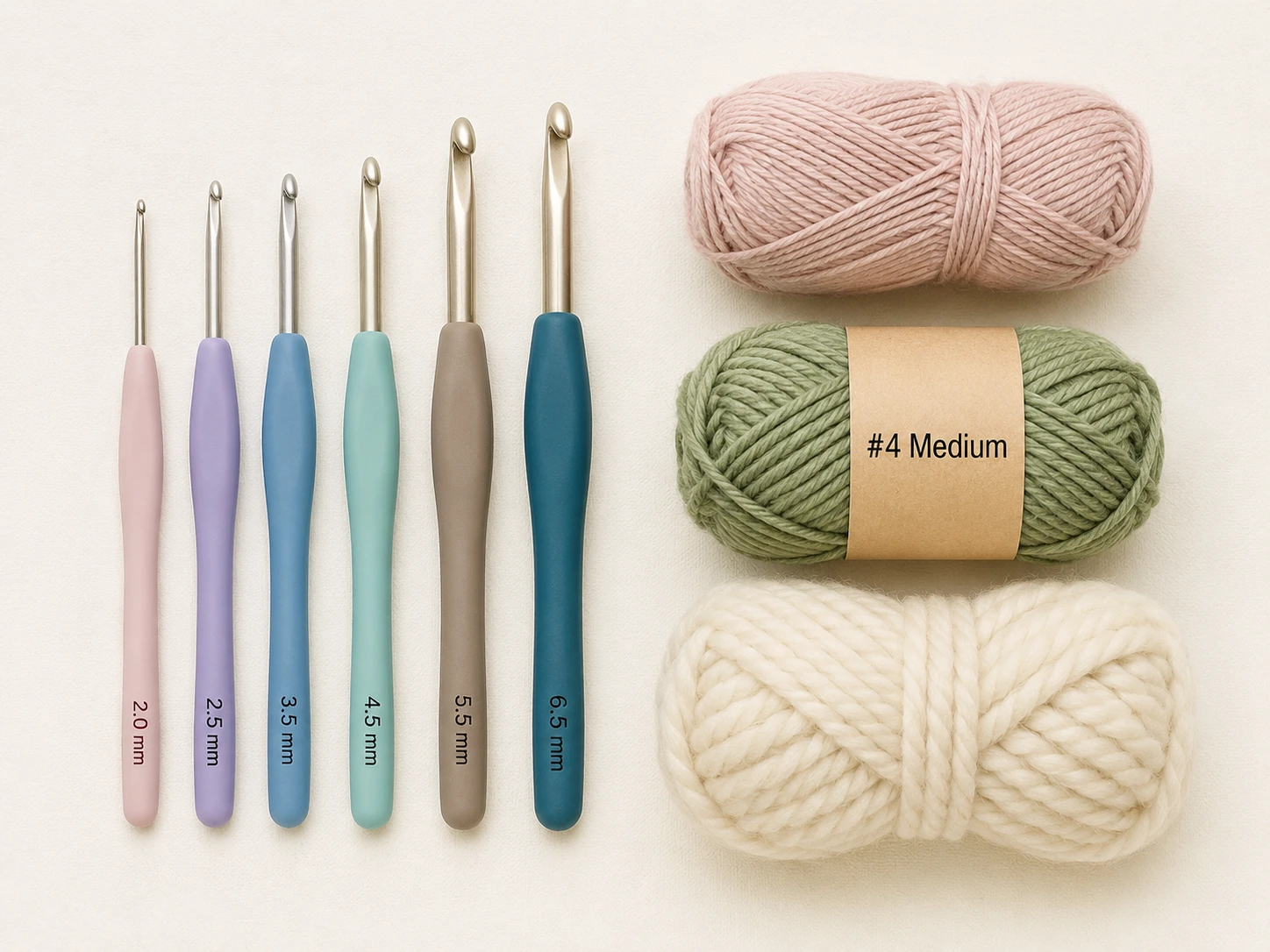
Crochet hook sizes and yarn weights can feel confusing at first, especially when one pattern says 5.5 mm, another says I-9, and the yarn label shows a large number 4.
The good news is that these numbers describe different things. Yarn weight tells you how thick the yarn is, while crochet hook size tells you the diameter of the hook. The two work together to control how tight, loose, thick, or flexible your crochet fabric becomes.
For most projects, start with the hook size listed in the pattern. If you are working without a pattern, the yarn label gives you a useful starting point. From there, you can adjust the hook size based on your gauge and the type of fabric you want.
If you are still learning the basic stitches and how to hold your hook and yarn, start with our crochet guide for absolute beginners.
Crochet Hook Size vs. Yarn Weight: What’s the Difference?
Understanding crochet hook sizes and yarn weights together makes it much easier to choose the right materials for a project.
A crochet hook size describes the size of the hook itself. In the United States, hooks may be labeled with a letter and number, such as H-8 or I-9, as well as a metric measurement such as 5 mm or 5.5 mm.
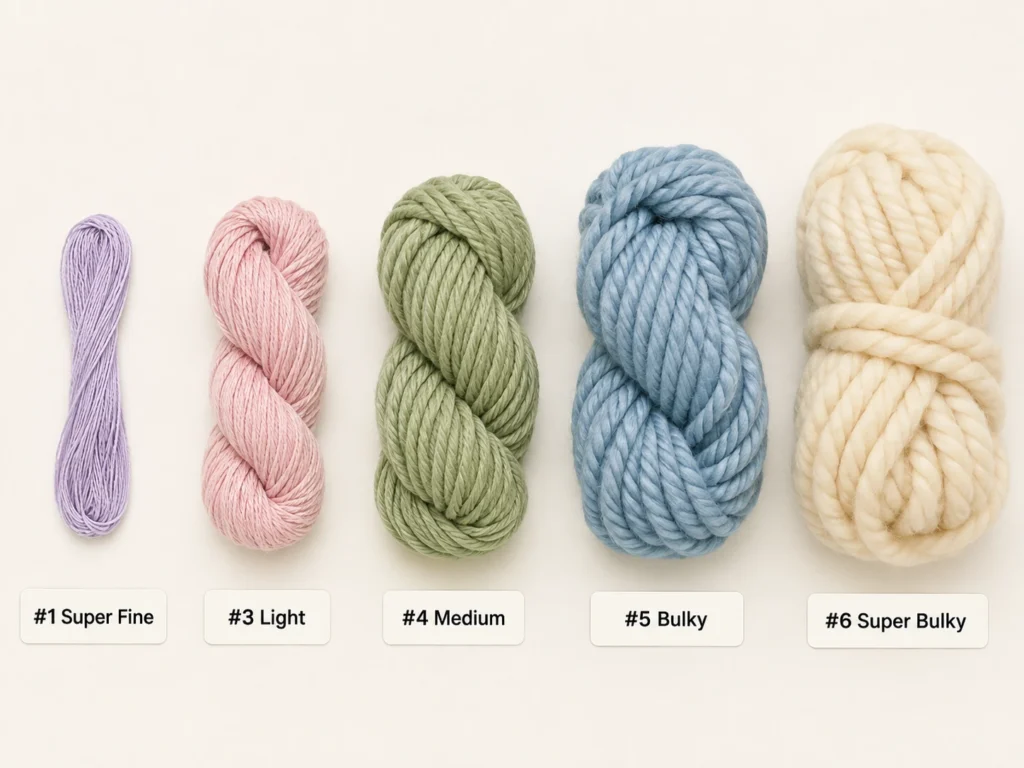
A yarn weight describes the thickness of the yarn. Under the Craft Yarn Council system, yarn weights are numbered from 0 to 7, with 0 representing the finest yarns and 7 representing the thickest.
For example:
- #2 Fine yarn is relatively thin.
- #4 Medium yarn includes many worsted-weight yarns.
- #6 Super Bulky yarn is much thicker.
A thicker yarn usually needs a larger hook, but that does not mean every yarn within the same weight category needs exactly the same size hook.
Common Crochet Hook Sizes
Crochet hooks are commonly marked in millimeters and U.S. letter or number sizes.
For example:
| Metric size | Common U.S. size |
|---|---|
| 3.5 mm | E-4 |
| 4 mm | G-6 |
| 4.5 mm | 7 |
| 5 mm | H-8 |
| 5.5 mm | I-9 |
| 6 mm | J-10 |
| 6.5 mm | K-10½ |
| 8 mm | L-11 |
| 9 mm | M/N-13 |
| 10 mm | N/P-15 |
There is one detail beginners should know: U.S. hook letters are not perfectly standardized between every manufacturer. You can compare common metric and U.S. measurements using the Craft Yarn Council crochet hook size chart. The Craft Yarn Council recommends relying on the millimeter measurement because it represents the actual hook diameter.
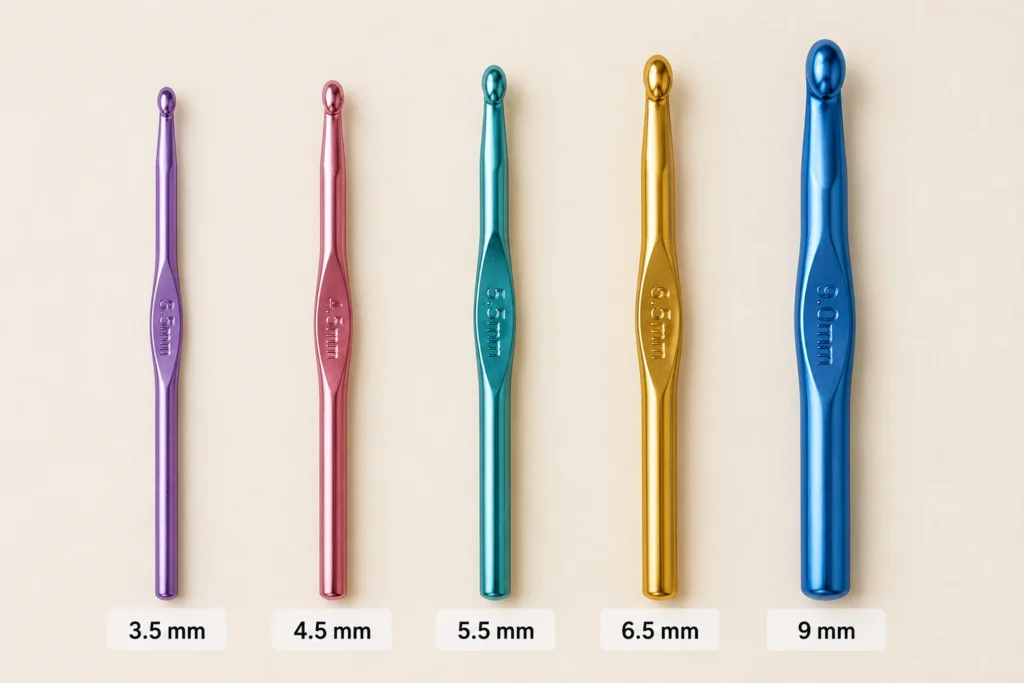
So if one hook is labeled “J” and another hook from a different brand is also labeled “J,” check the millimeter numbers before assuming they are identical.
Which number should you pay attention to?
Use the millimeter size first.
For example, if your pattern requests a 5.5 mm hook, choose a hook marked 5.5 mm even if you are unsure about the U.S. letter printed beside it.
This becomes especially useful when buying hooks online or using hooks from several brands.
What Does Yarn Weight Mean?
Yarn weight refers to the thickness of the yarn strand, not how much the ball or skein weighs.
A yarn labeled #4 Medium does not mean the skein weighs four ounces. The number identifies its thickness category.
The Craft Yarn Council’s Standard Yarn Weight System groups yarn into standardized weight categories and provides general hook and gauge ranges.
| Yarn weight | Category | Common yarn names | Suggested crochet hook range |
|---|---|---|---|
| 0 | Lace | Lace, thread, very fine yarns | Follow yarn/pattern; fine steel hooks or small regular hooks are common |
| 1 | Super Fine | Sock, fingering, baby | 2.25–3.5 mm |
| 2 | Fine | Sport, baby | 3.5–4.5 mm |
| 3 | Light | DK, light worsted | 4.5–5.5 mm |
| 4 | Medium | Worsted, Afghan, Aran | 5.5–6.5 mm |
| 5 | Bulky | Chunky, craft, rug | 6.5–9 mm |
| 6 | Super Bulky | Super bulky, roving | 9–15 mm |
| 7 | Jumbo | Jumbo, roving | 15 mm and larger |
These hook ranges are guidelines from the Craft Yarn Council rather than rules. The council specifically recommends following the gauge given in your pattern because actual hook requirements can change with the yarn, stitch pattern, project, and crocheter’s tension.
A useful beginner shortcut
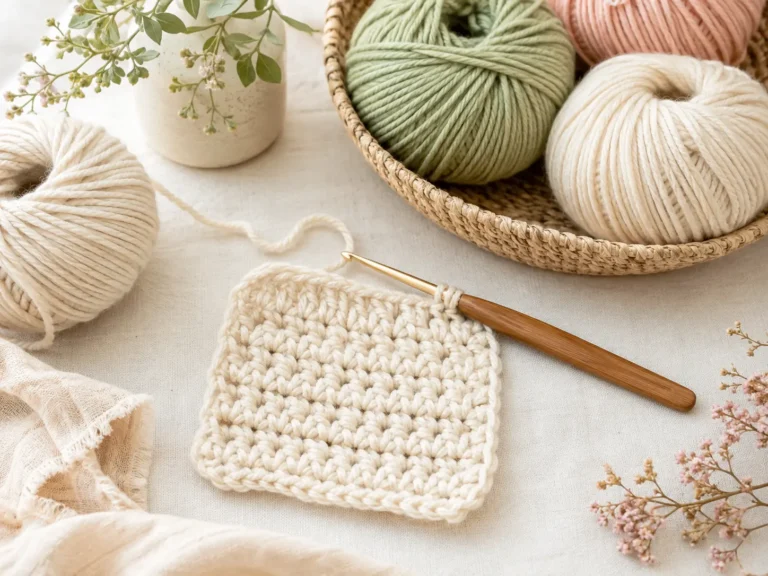
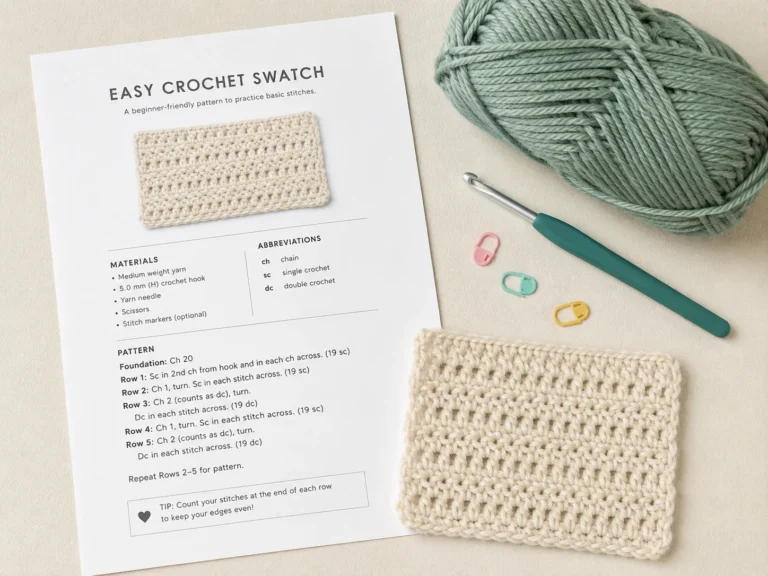
If you are learning basic crochet stitches without following a specific project, a smooth, light-colored #4 Medium yarn with approximately a 5.5 mm hook is a beginner-friendly combination.
The yarn is thick enough to see individual stitches without being so bulky that the fabric becomes difficult to control.
Avoid fuzzy or very dark yarn for your first practice swatch. It can make the top loops of each stitch harder to identify.
How to Choose the Right Crochet Hook for Your Yarn
If you have both a pattern and a yarn label in front of you, deciding which hook to use becomes much easier.
1. Follow the pattern first
If you are making a sized project such as a sweater, hat, bag, or fitted accessory, start with the hook listed in the pattern.
The designer chose that hook as part of the intended gauge and fabric.
Do not automatically replace it with the hook printed on your yarn label.
2. Check the yarn label
If you are crocheting without a pattern, look for the crochet hook symbol on the yarn label.
It usually gives you a recommended hook size or gauge information for that particular yarn.
Treat that number as your starting point, not a guarantee.
3. Crochet a small swatch
Make a small sample using your planned stitch.
Look at the fabric instead of judging the hook by its number alone.
Ask yourself:
- Are the stitches so tight that inserting the hook is difficult?
- Are large gaps appearing between stitches?
- Does the fabric feel stiff when you want it to drape?
- Does it feel too loose for a stuffed toy or structured project?
The correct hook is the one that produces the fabric and gauge your project requires.
What Happens When You Use a Smaller Crochet Hook?
Using a smaller hook generally produces smaller, tighter stitches and a denser fabric.
That can be useful for projects where you do not want large spaces between the stitches.
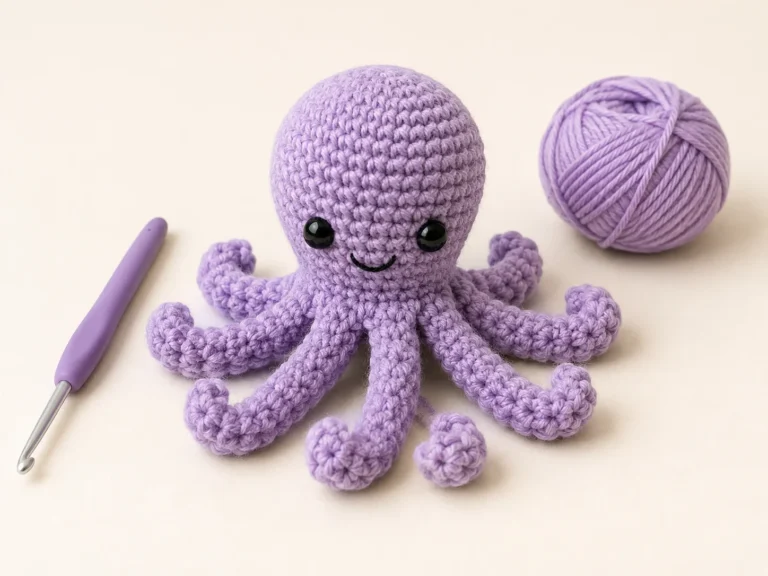
For example, amigurumi patterns often use a relatively small hook for the chosen yarn so stuffing is less likely to show through the fabric.
A smaller hook can also help with:
- structured baskets
- firm bags
- dense decorative pieces
- projects that need less open space between stitches
But going too small creates new problems.
Signs your hook may be too small
Your hook may be too small if:
- pushing it into each stitch takes noticeable effort
- your hands become tired quickly
- the fabric feels unusually stiff
- you struggle to pull yarn through loops
- the edges begin to curl because the stitches are extremely tight
Do not assume tighter crochet automatically means better crochet. The fabric still needs to suit the project.
What Happens When You Use a Larger Crochet Hook?
A larger hook generally creates larger stitches and a more open, flexible fabric.
This can be helpful for:
- scarves
- shawls
- loose garments
- open stitch patterns
- lace
- projects where you want more drape
Using a larger hook may also make it easier for a tight crocheter to match a pattern’s gauge.
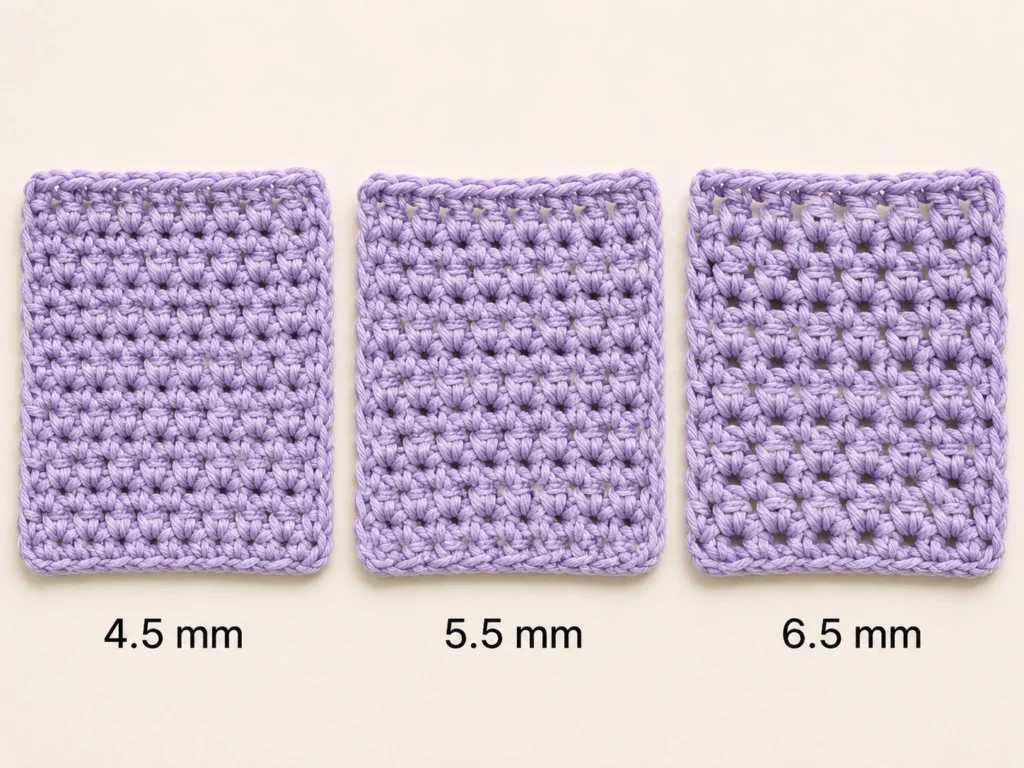
Signs your hook may be too large
Look closely at your fabric.
The hook may be too large if:
- the stitches look much more open than expected
- stuffing would be visible through an amigurumi piece
- the fabric has less structure than the project needs
- your finished measurements are larger than the pattern predicts
The goal is not to use the largest or smallest hook possible. It is to create the correct fabric.
Why Gauge Matters More Than the Hook Number
Two people can use the same yarn and the same hook but produce different-sized stitches.
That happens because every crocheter holds and tensions the yarn slightly differently.
Gauge tells you how many stitches and rows fit into a specific measurement, commonly 4 inches in U.S. patterns.
Suppose a pattern says:
14 single crochet stitches = 4 inches
Crochet a swatch and measure 4 inches across the center.
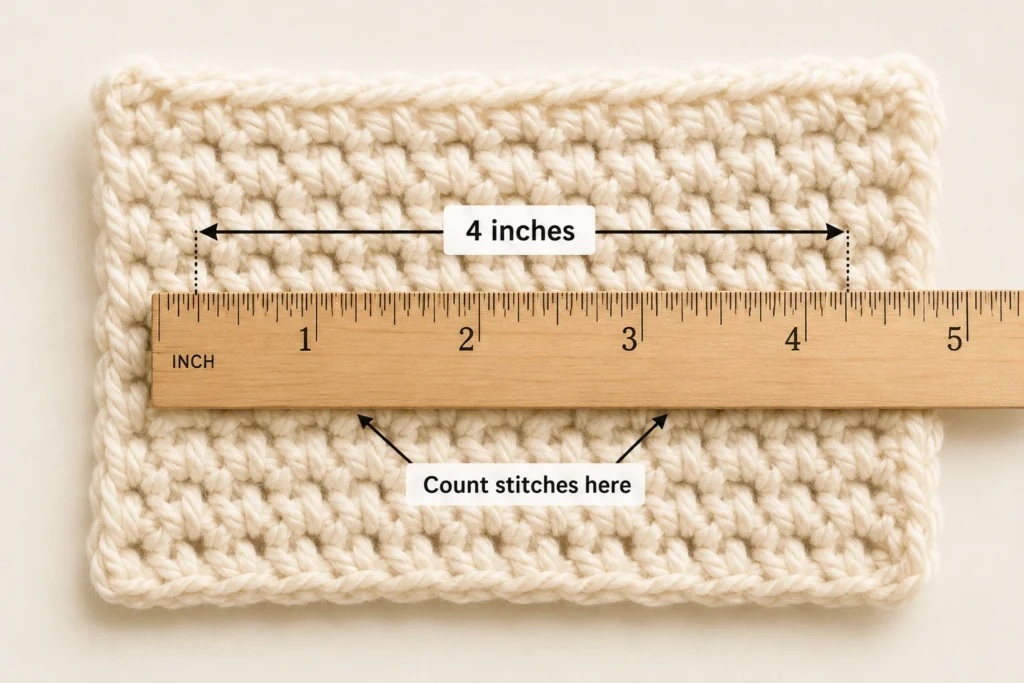
If you have more than 14 stitches
For example:
16 stitches = 4 inches
Your stitches are smaller than the pattern’s stitches.
Try a larger hook.
If you have fewer than 14 stitches
For example:
12 stitches = 4 inches
Your stitches are larger than the pattern’s stitches.
Try a smaller hook.
The Craft Yarn Council gives the same general guidance: use a smaller hook when your swatch is too large and a larger hook when your swatch is too small.
For a coaster, a small gauge difference might not matter much. For a sweater, hat, fitted garment, or anything where finished measurements matter, it can make a major difference.
Yarn Weight Does Not Guarantee Two Yarns Are Interchangeable
This is one of the easiest mistakes to make when substituting yarn.
Two skeins can both say #4 Medium and still behave differently.
They may differ in:
- fiber content
- strand construction
- thickness within the category
- elasticity
- texture
- softness
- drape
- yards per ounce or gram
The Craft Yarn Council specifically warns that the yarn weight system should not be treated as an interchangeability chart. Even two yarns in the same weight category should be swatched before one replaces the other in a pattern.
A better way to substitute yarn
When replacing the yarn in a pattern, compare:
- Yarn weight number
- Fiber content
- Recommended gauge
- Recommended hook size
- Yardage for a similar skein weight
- Your finished swatch
For example, two #4 yarns may technically belong to the same category, but one may produce a noticeably thicker or stiffer fabric.
The swatch gives you the answer that the label cannot.
How to Read the Yarn Weight Symbol
On many yarn labels sold in the United States, look for a small yarn skein symbol containing a number from 0 to 7.
The number indicates the yarn weight category:
0 = finest
7 = thickest
The system is designed to make yarn thickness easier to compare across brands.
Do not confuse the yarn weight symbol with:
- the total weight of the skein
- the number of yards
- the dye lot
- the recommended hook size
They describe completely different things.
What If Your Yarn Has No Label?
Maybe you inherited a bag of yarn, lost the wrapper, or have leftover yarn from an older project.
You can make a rough estimate using wraps per inch (WPI), a method that compares how many yarn wraps fit within one inch.
How to measure yarn using WPI
- Place the yarn around a pencil, ruler, or another object with an even width.
- Wrap the yarn beside itself without overlapping the strands.
- Keep the yarn snug but do not stretch or pull it tightly.
- Place a ruler beside the wraps.
- Count how many strands fit across one inch.
- Compare the result with a yarn-weight chart.
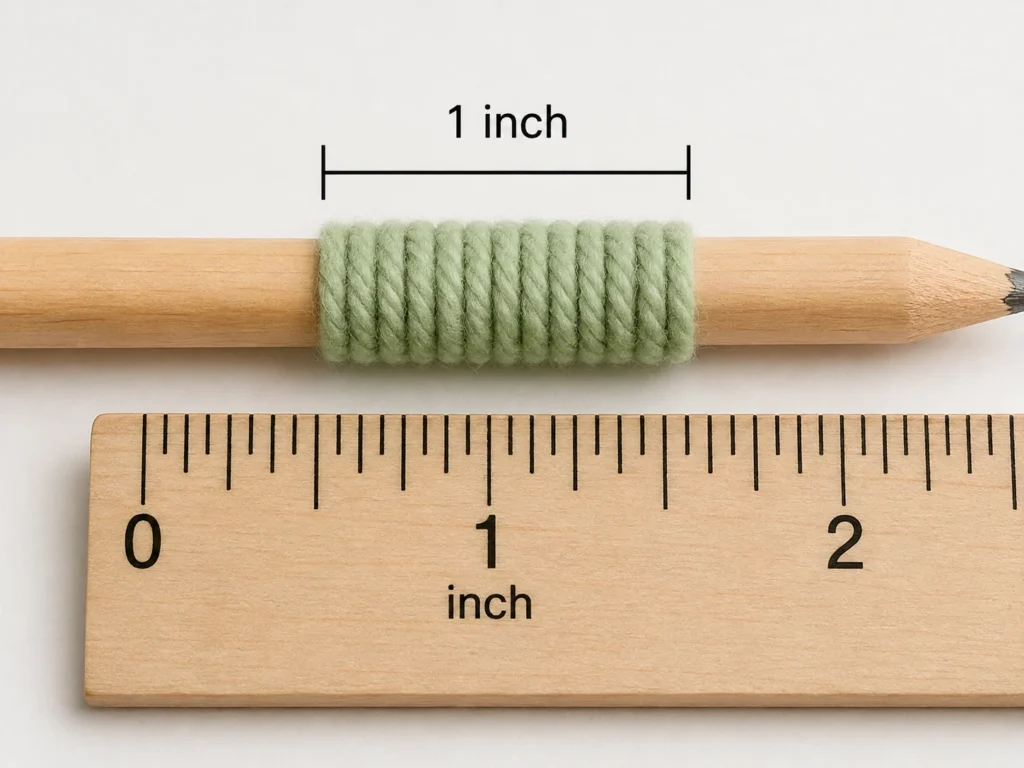
The Craft Yarn Council gives these approximate WPI ranges:
| Yarn weight | Approximate WPI |
|---|---|
| 0 Lace | 30–40+ |
| 1 Super Fine | 14–30 |
| 2 Fine | 12–18 |
| 3 Light | 11–15 |
| 4 Medium | 9–12 |
| 5 Bulky | 6–9 |
| 6 Super Bulky | 5–6 |
| 7 Jumbo | 1–4 |
Notice that some ranges overlap. That is normal.
WPI is an estimate because the result changes depending on how tightly you wrap the yarn. The Craft Yarn Council recommends treating WPI as a helpful identification method rather than an exact substitute for making a gauge swatch.
Which Crochet Hook Size Is Best for Beginners?
There is no single required beginner hook size, but 5 mm to 5.5 mm hooks paired with a smooth medium-weight yarn are manageable choices for learning basic stitches.
If you want to stay close to the Craft Yarn Council’s standard range for #4 Medium yarn, a 5.5 mm hook is a practical place to begin.
A medium hook is large enough that you can see the loops clearly but small enough that your first swatch does not become extremely bulky.
Lia’s Tip: When I was learning, a smooth medium-weight yarn made it much easier to see where the hook should go and to spot missed stitches.
For easier practice, choose yarn that is:
- smooth rather than fuzzy
- light or medium in color
- made from one consistent strand
- clearly labeled with its weight
- inexpensive enough that you do not mind unraveling and trying again
After you are comfortable making chains and basic stitches, experimenting with thinner and thicker yarns becomes much easier.
Which Hook Should You Use for Common Crochet Projects?
The pattern should always take priority, but project type can help explain why designers choose certain hook sizes.
Amigurumi
Amigurumi usually needs dense fabric so stuffing does not show through.
That is why a pattern may use a smaller hook than you expected for the yarn.
Do not reduce the hook automatically, though. Follow the pattern unless you have a specific reason to adjust it.
Granny squares
A granny square needs enough space for stitch groups and chain spaces to sit comfortably.
A hook that is too small may make the square stiff or cause it to cup.
A hook that is too large can make the clusters unusually loose.
Scarves and shawls
These projects often benefit from softer drape.
Depending on the stitch pattern, a designer may choose a hook toward the larger end of the recommended range.
Bags and baskets
Structured projects usually need firmer fabric than scarves.
That may mean working with a smaller hook, a dense stitch, or both.
Garments
For clothing, do not choose the hook based only on the yarn weight chart.
Match the pattern gauge.
Even a small gauge difference repeated across dozens of stitches can noticeably change the finished size.
Common Crochet Hook and Yarn Mistakes
Mistake 1: Thinking the yarn weight number is the hook size
A #4 yarn does not require a 4 mm hook.
The yarn number describes its thickness category. The hook measurement describes the hook diameter.
They are separate systems.
Mistake 2: Looking only at the U.S. hook letter
Because letters and numbers can vary between hook manufacturers, check the millimeter measurement whenever possible.
Mistake 3: Assuming the yarn label overrules the pattern
The yarn label gives a general recommendation.
A pattern may intentionally use a smaller or larger hook to create a particular fabric.
Start with the pattern’s hook and then check your gauge.
Mistake 4: Changing yarn without making a swatch
Matching the yarn weight number is a good first step, but it does not prove that the replacement yarn will behave exactly like the original.
Make a swatch before committing to a large project.
Mistake 5: Changing several things at once
If your gauge is wrong, change one hook size at a time, crochet another swatch, and measure again.
If you simultaneously change your hook, yarn, stitch tension, and pattern instructions, it becomes difficult to identify what fixed the problem.
A Simple Hook-and-Yarn Decision Guide
If you are unsure what to use, follow this order:
Following a pattern?
Use the yarn weight and hook size listed in the pattern.
Gauge does not match?
Change the hook size and swatch again.
No pattern?
Start with the recommendation on the yarn label.
No yarn label?
Estimate the yarn weight using WPI, choose a hook within the corresponding range, and make a test swatch.
Making amigurumi or another dense project?
Expect a firmer fabric and follow the project’s recommended hook.
Making a soft shawl or open fabric?
A larger hook may be appropriate, depending on the stitch pattern.
Quick Crochet Hook and Yarn Weight Cheat Sheet
For a simple reference:
| Yarn | Start around |
|---|---|
| #1 Super Fine | 2.25–3.5 mm hook |
| #2 Fine | 3.5–4.5 mm hook |
| #3 Light | 4.5–5.5 mm hook |
| #4 Medium | 5.5–6.5 mm hook |
| #5 Bulky | 6.5–9 mm hook |
| #6 Super Bulky | 9–15 mm hook |
| #7 Jumbo | 15 mm+ hook |
These are starting ranges, not mandatory pairings. Always use the pattern and gauge when they are available.
Frequently Asked Questions
What crochet hook should I use with #4 worsted-weight yarn?
The Craft Yarn Council’s general range for #4 Medium yarn is 5.5 to 6.5 mm. Your individual yarn label or pattern may recommend a different size, so use its instructions when available.
Can I use a different hook size than the yarn label recommends?
Yes. The label gives you a starting point. Crochet patterns sometimes intentionally use a smaller or larger hook to produce a denser, looser, stiffer, or more drapey fabric.
For projects where dimensions matter, check your gauge before continuing.
Is a larger crochet hook always used with thicker yarn?
Usually thicker yarns are paired with larger hooks, but there are exceptions. Lace projects may use surprisingly large hooks to produce open fabric, while dense projects may use a smaller hook for the yarn.
Why does my hook have both a letter and a millimeter number?
The letter is part of a U.S. sizing system, while the millimeter number describes the hook’s actual diameter. Since letter sizing can vary between manufacturers, the millimeter measurement is the safer number to compare.
Can I crochet with any yarn using any hook?
Technically, you can experiment with many combinations, but the result may not suit the project. A very small hook with thick yarn can create stiff, difficult fabric, while a very large hook with thin yarn can create large open spaces.
Start with the pattern or yarn-label recommendation, then adjust deliberately.
The Rule Worth Remembering
You do not need to memorize every crochet hook size or yarn weight.
Remember this instead:
The pattern tells you where to start, the yarn label gives you guidance, and your gauge tells you whether the combination is actually working.
For beginners practicing without a pattern, a smooth #4 Medium yarn and a medium-size hook such as 5.5 mm keep things simple. Once you understand how changing the hook affects your stitches, choosing yarn and hook combinations becomes much less confusing.
3 Comments