How to Double Crochet for Beginners: Easy Step-by-Step Guide
How to double crochet becomes much easier once you know where to insert the hook and how many loops should remain after each movement. In this beginner tutorial, you’ll practice the U.S. double crochet stitch from a foundation chain using the simple 3 loops → 2 loops → 1 loop sequence.
You’ll also learn how to start the next row, keep straight edges, count your stitches, and fix the mistakes that commonly make beginner swatches wider or narrower.
Quick Answer: To make a U.S. double crochet, yarn over, insert your hook into the stitch, yarn over and pull up a loop, then yarn over and pull through 2 loops twice. You should move from 3 loops → 2 loops → 1 loop on your hook.
What Is a Double Crochet Stitch?
A double crochet stitch is a tall basic crochet stitch made by yarning over before inserting the hook, then pulling the yarn through the loops in two stages.
In U.S. terminology, it is written as dc. The finished stitch is taller than a single crochet stitch, so rows build height more quickly.
The basic motion is:
- Yarn over.
- Insert the hook.
- Yarn over and pull up a loop.
- Yarn over and pull through 2 loops.
- Yarn over and pull through the remaining 2 loops.
You finish with one loop left on your hook.
Important: U.S. vs. UK Double Crochet
This tutorial uses U.S. crochet terminology.
A U.S. double crochet is called a treble crochet in UK terminology. A UK double crochet is actually equivalent to a U.S. single crochet.
Always check which terminology a pattern uses before starting.
What You Need to Practice Double Crochet
You do not need a complete crochet kit to learn this stitch.
For a beginner practice swatch, use:
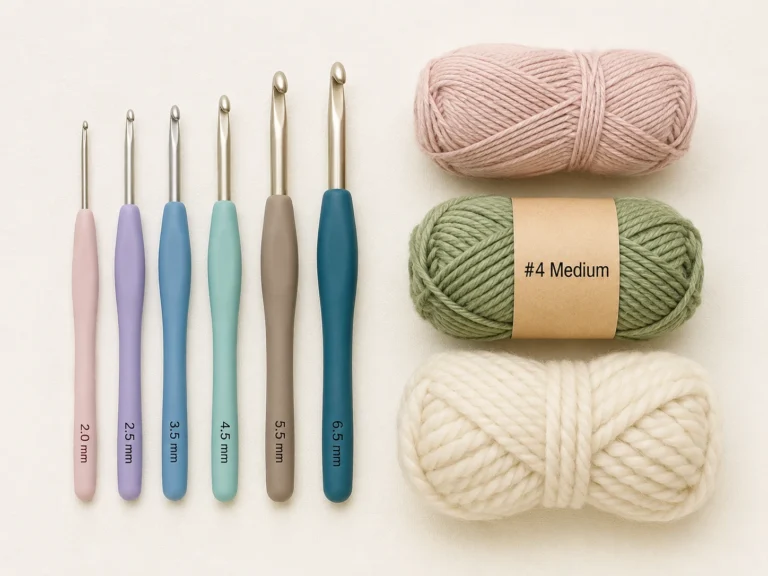
- Smooth #4 medium/worsted-weight yarn
- A 5.0 mm crochet hook
If the numbers on yarn labels and crochet hooks are still confusing, our guide to crochet hook sizes and yarn weights explains how they work. - Scissors
- Yarn needle for weaving in the ends
A light or medium yarn color makes the individual loops easier to see than black, dark navy, fuzzy, or heavily textured yarn.
For your first practice piece, the exact brand of yarn is not important. The goal is to see the stitch structure clearly and practice consistent movements.
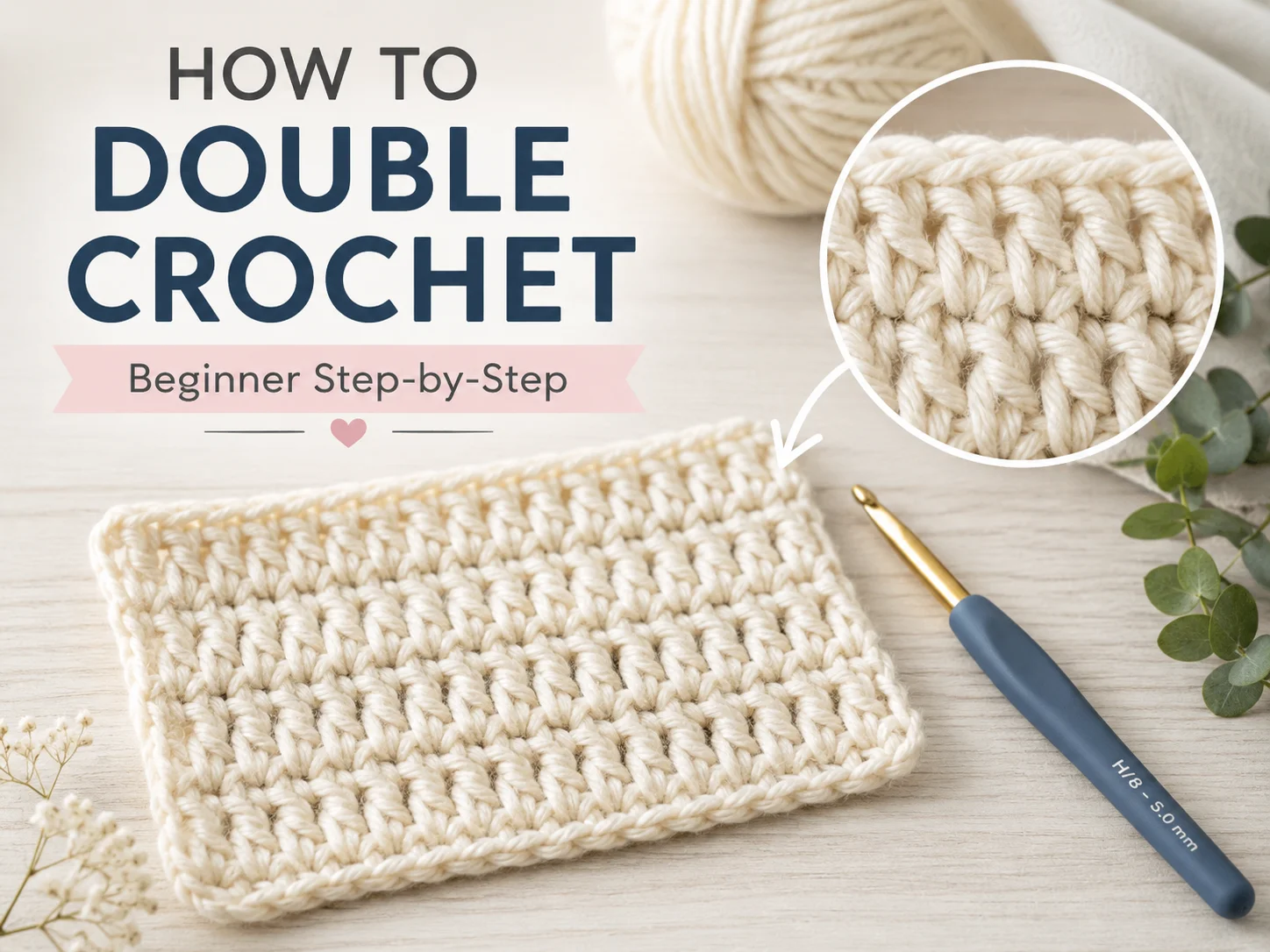
For the swatch shown in this tutorial, I used smooth #4 medium-weight yarn with a 5.0 mm crochet hook so the loops and stitch tops would be easy to see in the photos.
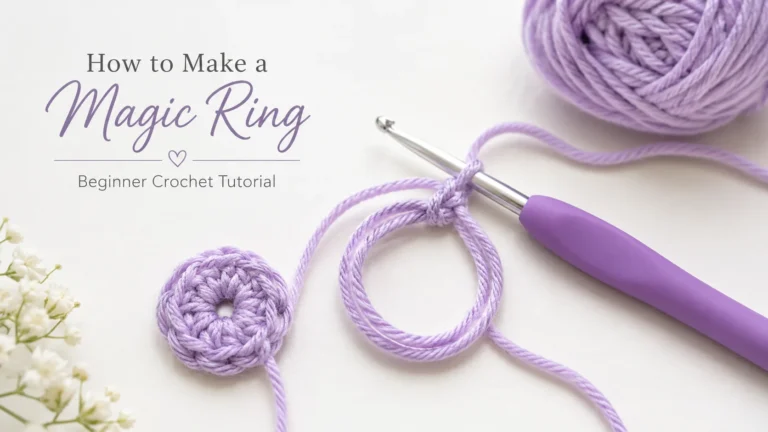
If holding your hook, making a slip knot, or creating a foundation chain still feels unfamiliar, start with our crochet guide for absolute beginners first.
For your first practice swatch, smooth medium-weight yarn makes the stitch structure easier to see
Before You Start: Know the Parts of a Chain
Look at the front of your foundation chain before inserting the hook.
Each chain has a small V shape. Unless your pattern tells you to work somewhere else, beginners can insert the hook under the top loops of the chain as instructed by the pattern.
Also remember:
The loop currently sitting on your hook is never counted as a chain stitch.
That matters when you count to the fourth chain in the first row.
How to Double Crochet for Beginners Step by Step
For this practice swatch, make 12 chains.
Using the conventional beginning chain-3 method described by the Craft Yarn Council, you will work your first double crochet into the fourth chain from the hook. The three skipped chains act as the first double crochet.
This will give you a practice row of 10 stitches total.
Step 1: Yarn Over
Bring the working yarn over the hook from back to front.
You should now have the original loop plus the yarn wrapped over the hook.
Do not pull the yarn tightly against the hook. It needs enough room to move through the other loops.
Beginner mistake: Skipping this first yarn over changes the stitch completely.
Step 2: Insert the Hook Into the Fourth Chain
Starting from the hook, count:
1, 2, 3, 4
Do not count the loop already on the hook.
Insert your hook into the fourth chain from the hook.
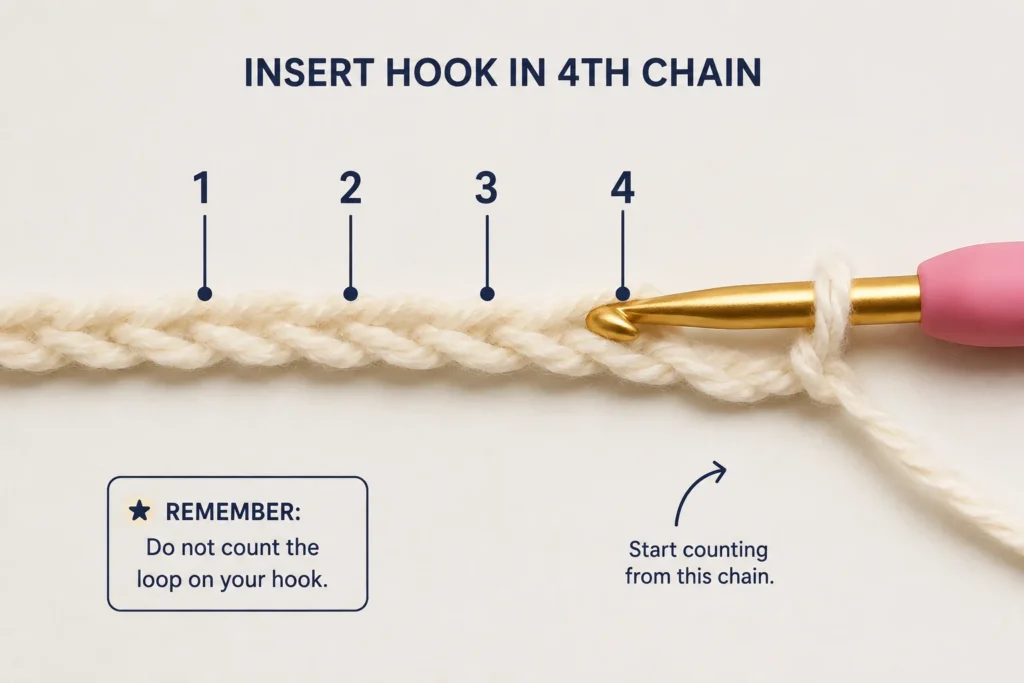
The first three chains remain unworked because they provide the height for the beginning of the row and, with this method, count as the first double crochet.
Step 3: Yarn Over and Pull Up a Loop
Wrap the working yarn over your hook again.
Pull that yarn back through the chain where you inserted the hook.
Stop and look at your hook.
You should now have:
3 loops on the hook.
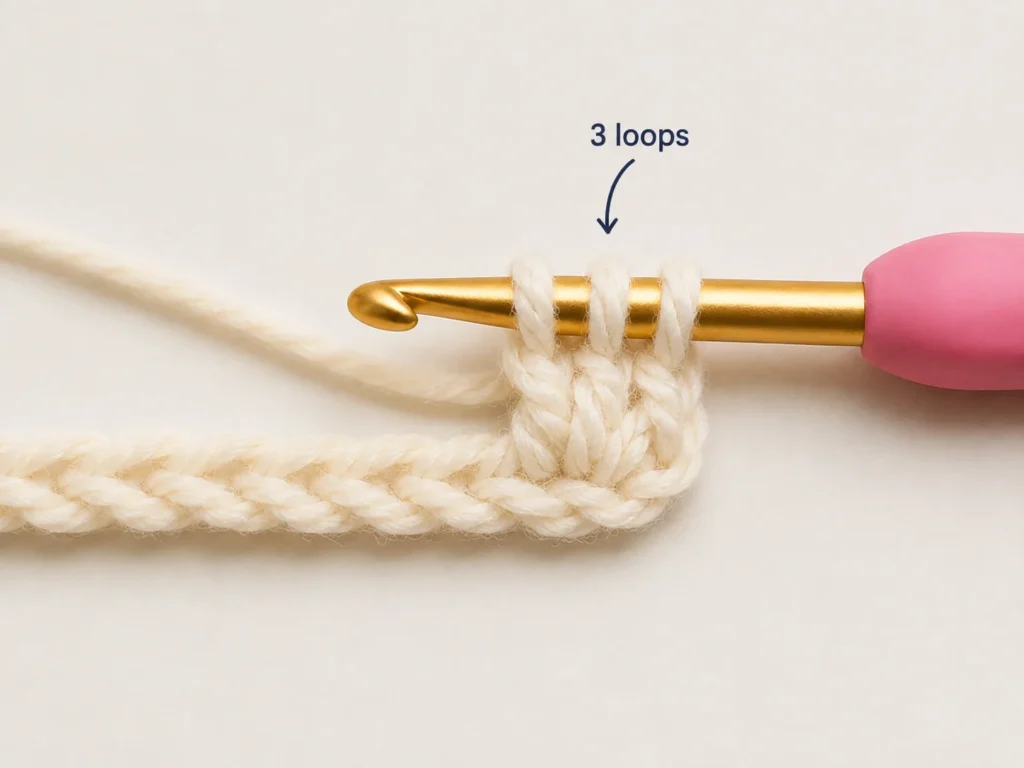
This is a useful checkpoint. If you have only two loops, you probably forgot the first yarn over.
The Craft Yarn Council also specifies three loops at this stage of a double crochet.
Step 4: Yarn Over and Pull Through Two Loops
Yarn over again.
Use the hook to pull that yarn through only the first two loops on your hook.
Do not pull it through all three.
After this movement, you should have:
2 loops remaining on the hook.
Try to keep the hook moving smoothly rather than tightening the loops before pulling through them.
Step 5: Yarn Over and Pull Through the Last Two Loops
Yarn over one more time.
Pull the yarn through both remaining loops.
You should now have:
1 loop left on your hook.
Your first double crochet is complete.
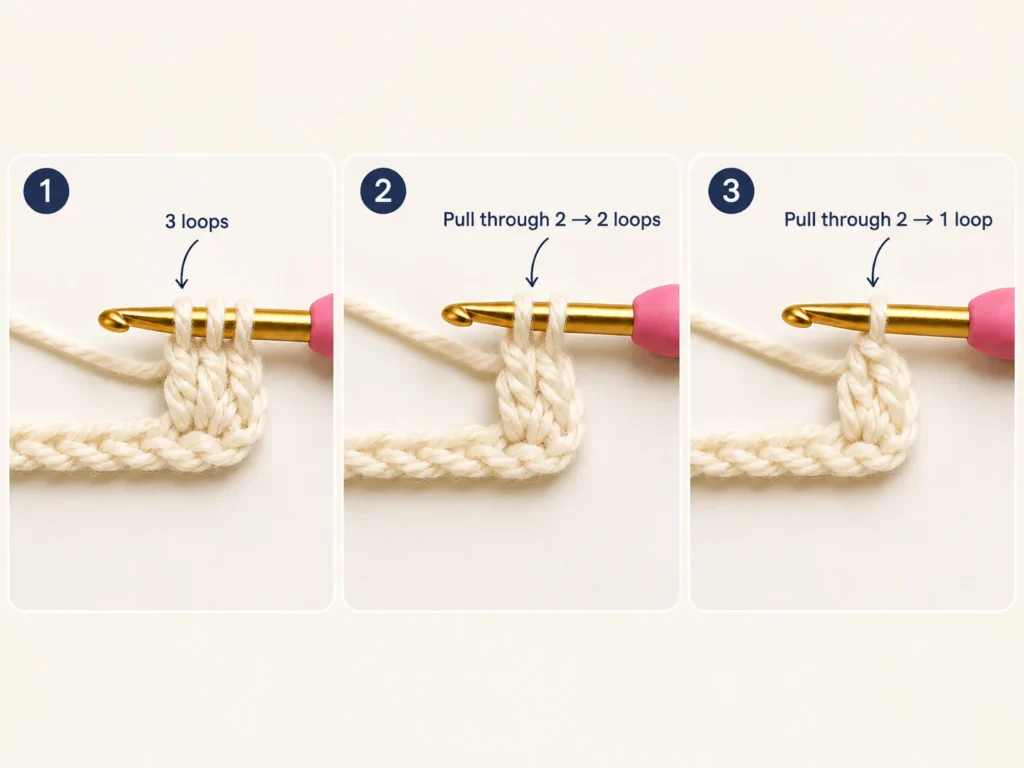
The Double Crochet Formula
If you forget the steps later, remember this short sequence:
YO → insert → YO, pull up → YO, through 2 → YO, through 2
Where YO means yarn over.
The loop checkpoints are:
1 loop → yarn over → 3 loops → 2 loops → 1 loop
Learning those checkpoints makes troubleshooting much easier.
Finish the First Row
Now work one double crochet into each remaining chain.
For every stitch:
- Yarn over.
- Insert the hook into the next chain.
- Yarn over and pull up a loop.
- Check for 3 loops.
- Yarn over and pull through 2 loops.
- Yarn over and pull through the final 2 loops.
Continue until you reach the end of the foundation chain.
For the 12-chain practice swatch, you physically make 9 double crochet stitches, while the three skipped beginning chains count as the first stitch.
Your row therefore contains:
10 stitches total.
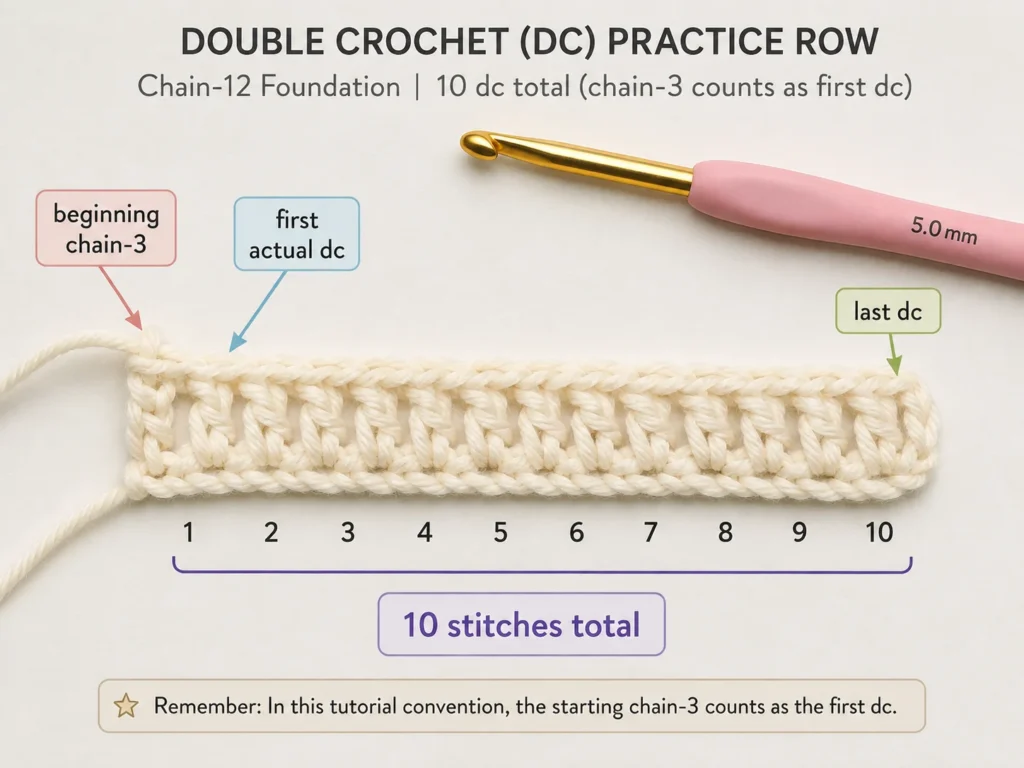
That distinction often confuses beginners. You have not missed a stitch.
How to Make the Second Row of Double Crochet
Now you need enough height to begin another row.
Step 1: Chain 3
Make three chain stitches.
For this practice swatch, the chain-3 counts as the first double crochet of the new row.
The Craft Yarn Council describes chain 3 as the conventional turning chain for double crochet and treats it as the first stitch unless a pattern says otherwise.
Step 2: Turn Your Work
Turn the crochet piece so you can work back across the previous row.
Your chain-3 is now positioned at the beginning edge.
Step 3: Skip the Stitch Directly Below the Chain-3
Because the chain-3 counts as your first stitch, do not make another double crochet into the stitch directly at its base.
If you work there as well, you may accidentally add one stitch and your swatch will gradually get wider.
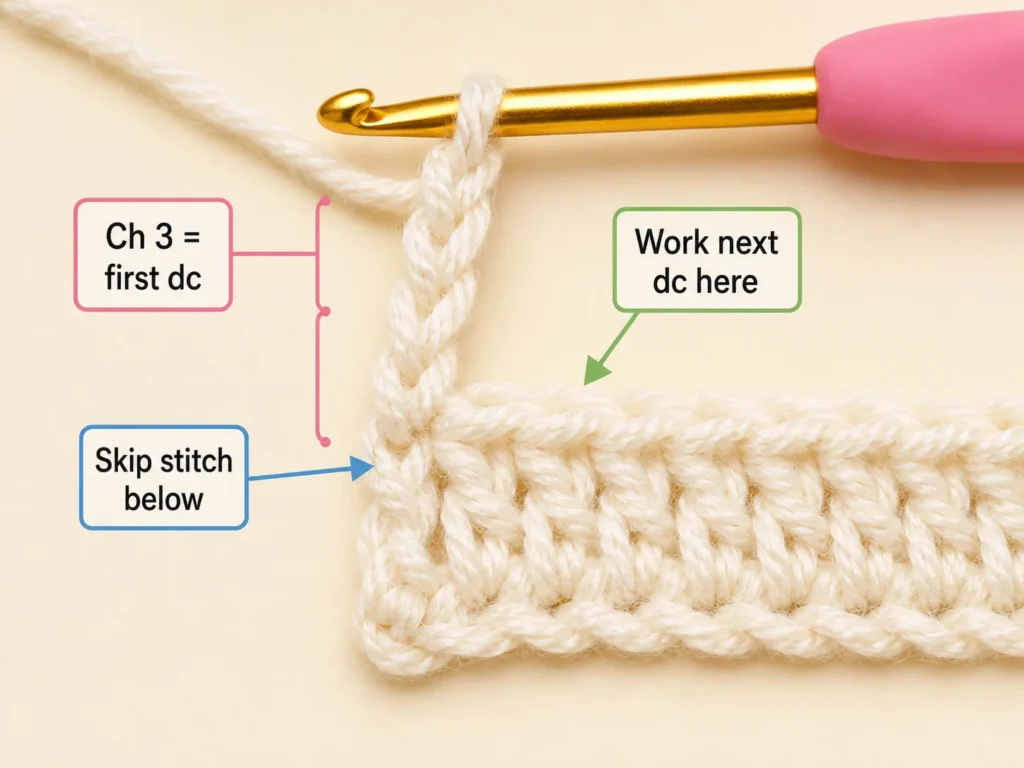
Step 4: Double Crochet Into the Next Stitch
Yarn over.
Insert the hook under the top two loops of the next stitch.
Then complete a normal double crochet:
Yarn over, pull up a loop, yarn over through 2, yarn over through 2.
Continue working one double crochet in each stitch across.
Step 5: Work Into the Top of the Turning Chain
The last stitch can be easy to miss.
Because the beginning chain-3 from the previous row counted as a stitch, your final double crochet should be worked into the top of that turning chain.
This keeps the stitch count consistent from row to row. The Craft Yarn Council likewise instructs crocheters to treat the beginning chain as a stitch when using this convention.
Count again.
You should still have:
10 stitches.
Does Chain 3 Always Count as a Double Crochet?
No. Follow the pattern you are using.
The traditional convention shown above uses a chain-3 that counts as the first double crochet. The Craft Yarn Council presents that method as its standard instructional approach.
However, you may encounter patterns that say:
- Ch 3, counts as first dc
- Ch 3, does not count as a stitch
- Ch 2, does not count as a stitch
- Use a different beginning-stitch method
Do not automatically apply one rule to every pattern.
Look for a note near the beginning of the instructions explaining whether the turning chain counts as a stitch.
How to Recognize a Double Crochet Stitch
A completed double crochet has:
- A tall vertical post
- A V-shaped top
- More height than a single crochet
- One stitch top that you work into on the next row
When counting stitches across a row, count the V shapes at the top, not the open spaces between the stitches.
If the turning chain counts as a stitch in your pattern, remember to count it too.
Common Double Crochet Mistakes and How to Fix Them
You Have Only Two Loops After Pulling Up the Yarn
You probably forgot to yarn over before inserting the hook.
Undo the stitch and begin again:
Yarn over first, then insert the hook.
You should reach three loops after pulling up the new loop.
You Have Four Loops on the Hook
You may have wrapped the yarn around the hook twice before inserting it.
A standard U.S. double crochet begins with one yarn over.
Remove the extra wrap and try again.
Your Swatch Keeps Getting Wider
Count the stitches in every row.
If your turning chain counts as the first double crochet, do not also work into the stitch directly underneath it unless your pattern specifically tells you to.
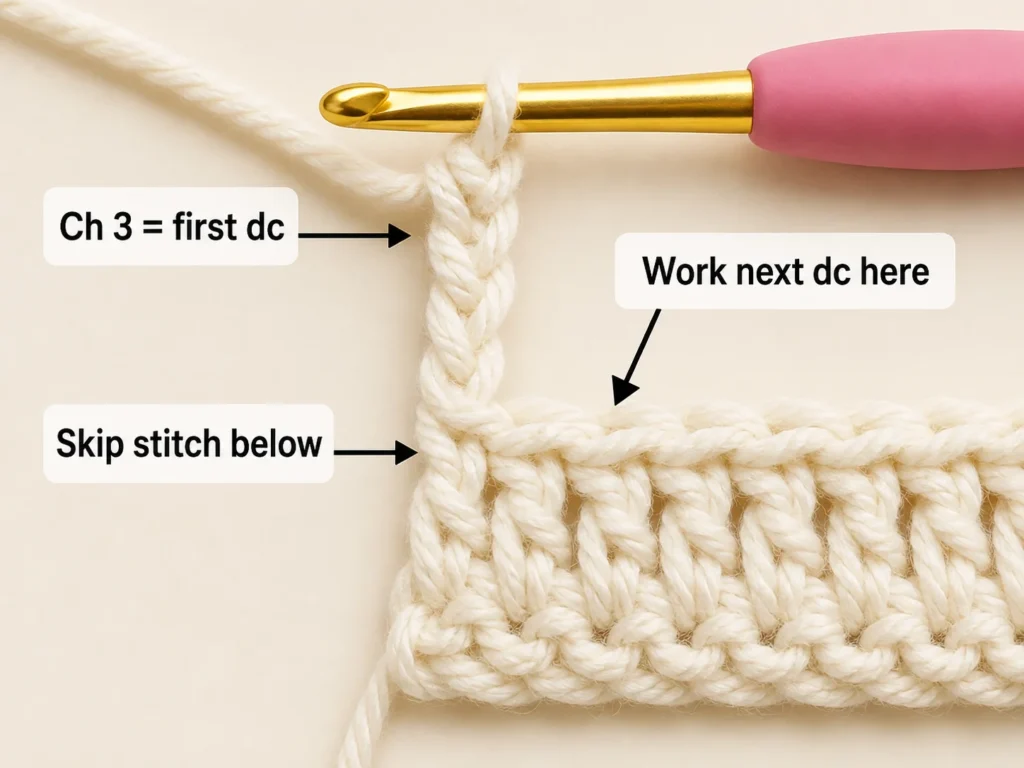
Adding a stitch at the beginning of each row creates expanding edges.
Your Swatch Keeps Getting Narrower
Check the last stitch of each row.
Beginners often miss the final stitch because it sits close to the edge and may look different from the others.
When your previous turning chain counts as a stitch, you may need to work the final stitch into the top of that chain.
Lia’s tip: The last stitch is the one I check first when a practice swatch starts getting narrower. It sits close to the turning chain and is much easier to miss than the stitches in the middle.
Your First Row Is Curving
A foundation chain that is much tighter than the double crochet stitches above it can pull the bottom edge inward.
Try making the chains slightly more relaxed.
You want the loops large enough for the hook to pass through without forcing it, but not so loose that the chain becomes floppy.
Your Stitches Look Different Heights
Watch how far you pull up the loop in Step 3.
If some loops are pulled very high while others stay tight against the hook, your stitches will have different heights.
Aim for similar loop sizes throughout the row.
There Is a Large Gap at the Beginning of Each Row
A traditional chain-3 can create a visible space beside the next stitch.
That does not necessarily mean the stitch is wrong.
Before changing the turning-chain method, check what your pattern expects. Changing whether the chain counts as a stitch can change the stitch count and edge construction.
A Simple 5-Row Practice Swatch
Before starting a project, practice keeping the same stitch count for several rows.
Foundation
Chain 12.
Row 1
Double crochet in the fourth chain from the hook and in every remaining chain across.
10 stitches total, counting the skipped chain-3 as the first stitch.
Rows 2–5
Chain 3 and turn.
Skip the stitch directly below the chain-3.
Double crochet in each stitch across, working the final stitch into the top of the previous turning chain.
Count after every row.
You should have:
10 stitches in every row.
Do not worry if the swatch is not perfectly square. The purpose is to practice stitch placement, loop control, and straight edges.
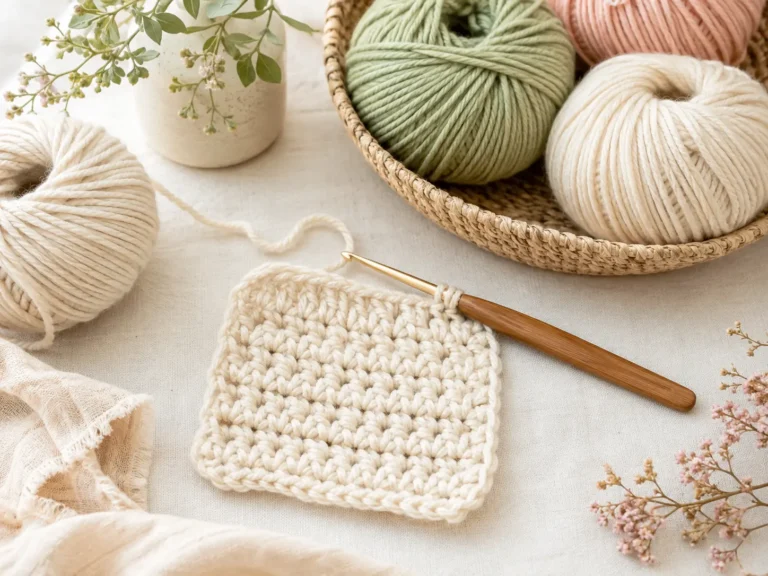
The finished swatch shown here was made row by row using the same 10-stitch count described above, so you can compare your edges and stitch spacing with the example.
Double Crochet vs. Single Crochet
The biggest difference is the extra yarn over and the way the loops are worked off the hook.
A double crochet starts with a yarn over and is taller than a single crochet.
That additional height makes double crochet useful when you want fabric to build faster or when a pattern needs taller stitches.
If you are still uncomfortable holding the hook, making chains, or controlling yarn tension, practice those basics before trying to make a large double-crochet project.
Where Double Crochet Is Used
After you can keep a practice swatch straight, you will start recognizing double crochet in many patterns.
It is commonly used for:
- Blankets
- Scarves
- Shawls
- Granny squares
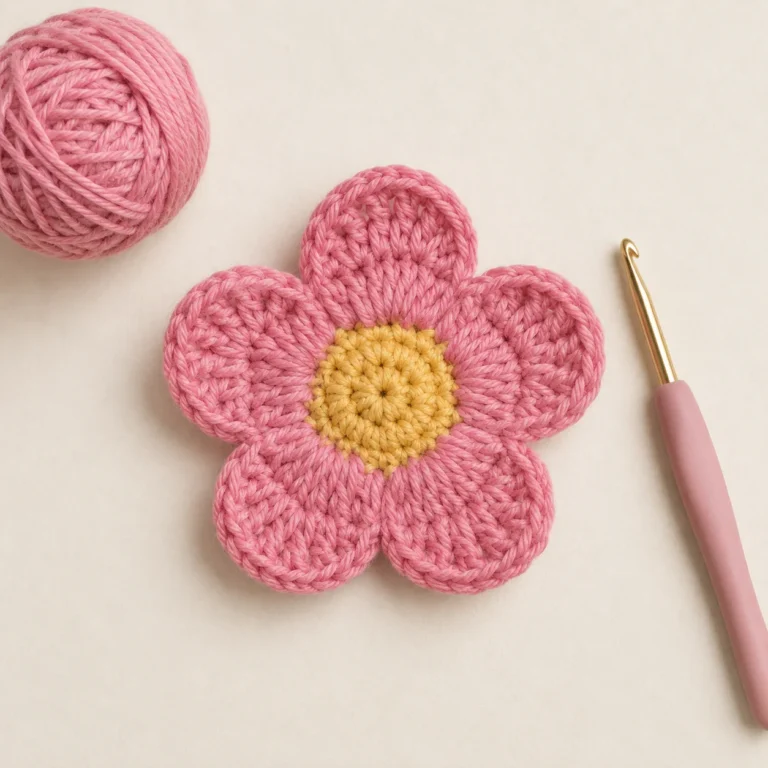
- Crochet flowers
- Garments
- Open or textured stitch patterns
Granny squares are especially useful practice because many traditional versions use groups of double crochet stitches separated by chain spaces.
How to Read Double Crochet in a Pattern
The standard U.S. abbreviation for double crochet is:
dc
The Craft Yarn Council lists dc = double crochet, ch = chain, st = stitch, and yo = yarn over in its standardized abbreviations.
If abbreviations such as dc, ch, st, and rep are new to you, learn how to read crochet patterns for beginners before starting your first written pattern.
A pattern instruction might say:
Dc in next 5 sts.
That means:
Work one double crochet into each of the next five stitches.
Another instruction might say:
2 dc in next st.
That means:
Work two separate double crochet stitches into the same stitch.
Learning these short instructions will make beginner patterns much easier to follow.
What Should You Practice Next?
This small swatch is a useful way to practice double crochet without starting a full project.
Do not rush into a large blanket after making one successful stitch.
First, try to crochet five rows with the same number of stitches in every row.
Check three things:
- Can you consistently finish each double crochet with one loop on the hook?
- Can you identify the first and last stitch of every row?
- Does your stitch count stay the same?
If all three are becoming comfortable, you are ready to use double crochet in simple projects, granny squares, flowers, and other beginner patterns.
The stitch itself is only five basic movements. The real skill is learning where each stitch begins and ends. Once you can see that structure clearly, double crochet becomes much easier to use without stopping to count every movement.
The key to learning double crochet is keeping the same stitch count while practicing the 3-loops-to-1-loop sequence.
Frequently Asked Questions
Why do I have three loops on my hook when double crocheting?
Three loops are exactly what you should have after you yarn over, insert the hook, yarn over again, and pull up a loop. Next, pull through two loops, then through the remaining two.
How many chains do I make before turning double crochet?
A traditional U.S. double crochet row commonly uses a chain-3 turning chain, but patterns may use different methods. Follow the specific pattern and check whether its turning chain counts as a stitch.
Why are the sides of my double crochet uneven?
The most common causes are accidentally adding a stitch beside the turning chain or missing the final stitch at the opposite edge. Count every row while practicing.
Can beginners learn double crochet before single crochet?
Yes, although learning the foundation chain and basic hook control first makes the process easier. Double crochet has more movements than single crochet, but the repeated pull-through-two sequence is straightforward once you understand it.
Can I use double crochet in a granny square?
Yes. Double crochet groups are used in many traditional granny-square constructions. Learning a consistent double crochet stitch is a useful next step before practicing granny squares.
What should a finished double crochet look like?
It should have a tall vertical post with a V-shaped stitch at the top. After the final pull-through, only one working loop should remain on your hook.
3 Comments